
What Vela users actually want
Mimir analyzed 1 public source — app reviews, Reddit threads, forum posts — and surfaced 3 patterns with 6 actionable recommendations.
This is a preview. Mimir does this with your customer interviews, support tickets, and analytics in under 60 seconds.
Top recommendation
AI-generated, ranked by impact and evidence strength
Build a time-savings dashboard that shows users exactly how many hours Vela has recovered each week
High impact · Small effort
Rationale
Users see thousands of meetings scheduled but lack a personal view of their own time recovered. Vela measures actual time saved post-deployment but doesn't surface this data to individual users in a way that reinforces value and drives retention. A dashboard showing weekly hours saved, meetings coordinated, and follow-ups eliminated would transform an abstract benefit into concrete proof.
This addresses the core positioning around returning professionals' most valuable resource while creating a retention mechanism. When users see "18 hours saved this month" they internalize Vela's value in business terms. For revenue growth, this data becomes a referral engine—users naturally share quantified wins with colleagues facing the same pain.
The dashboard also creates upsell opportunities by showing power users their exceptional usage patterns, making premium tiers or team licenses an easier conversation. Measuring time saved is already part of the product infrastructure, so surfacing it to users is primarily a front-end effort with outsized impact on both retention and organic growth.
Projected impact
The full product behind this analysis
Mimir doesn't just analyze — it's a complete product management workflow from feedback to shipped feature.
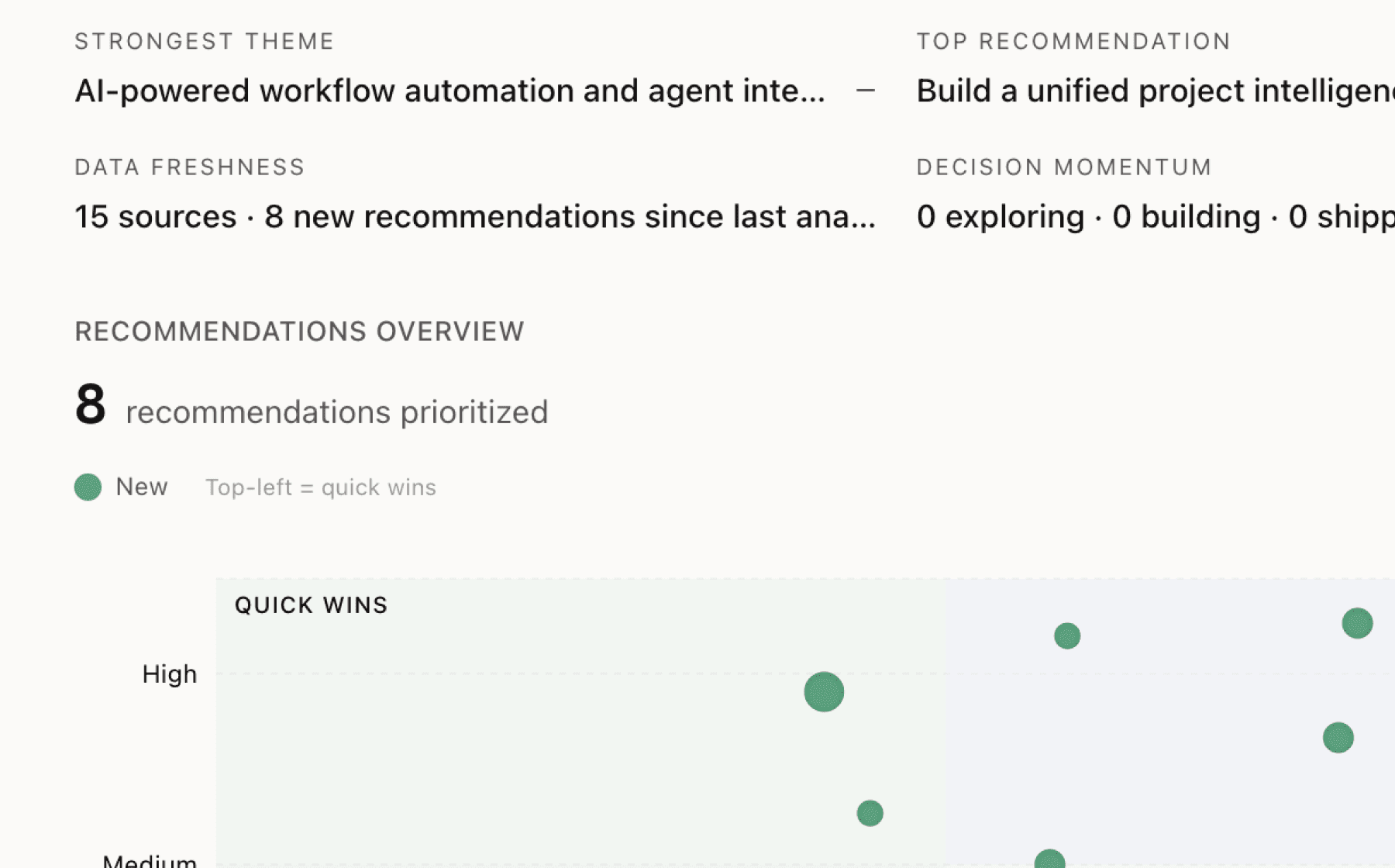
Evidence-backed insights
Every insight traces back to real customer signals. No hunches, no guesses.
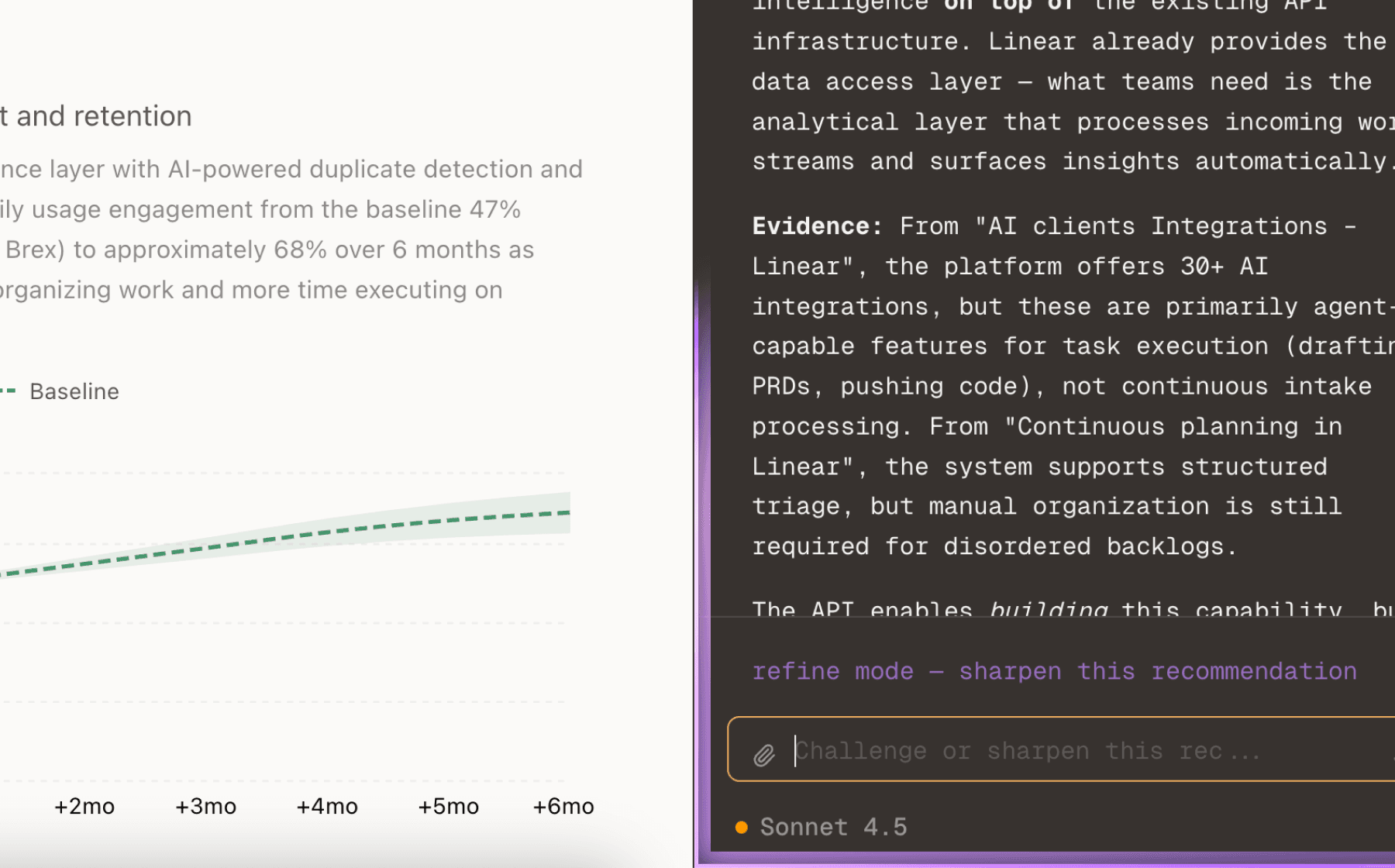
Chat with your data
Ask follow-up questions, refine recommendations, and capture business context through natural conversation.
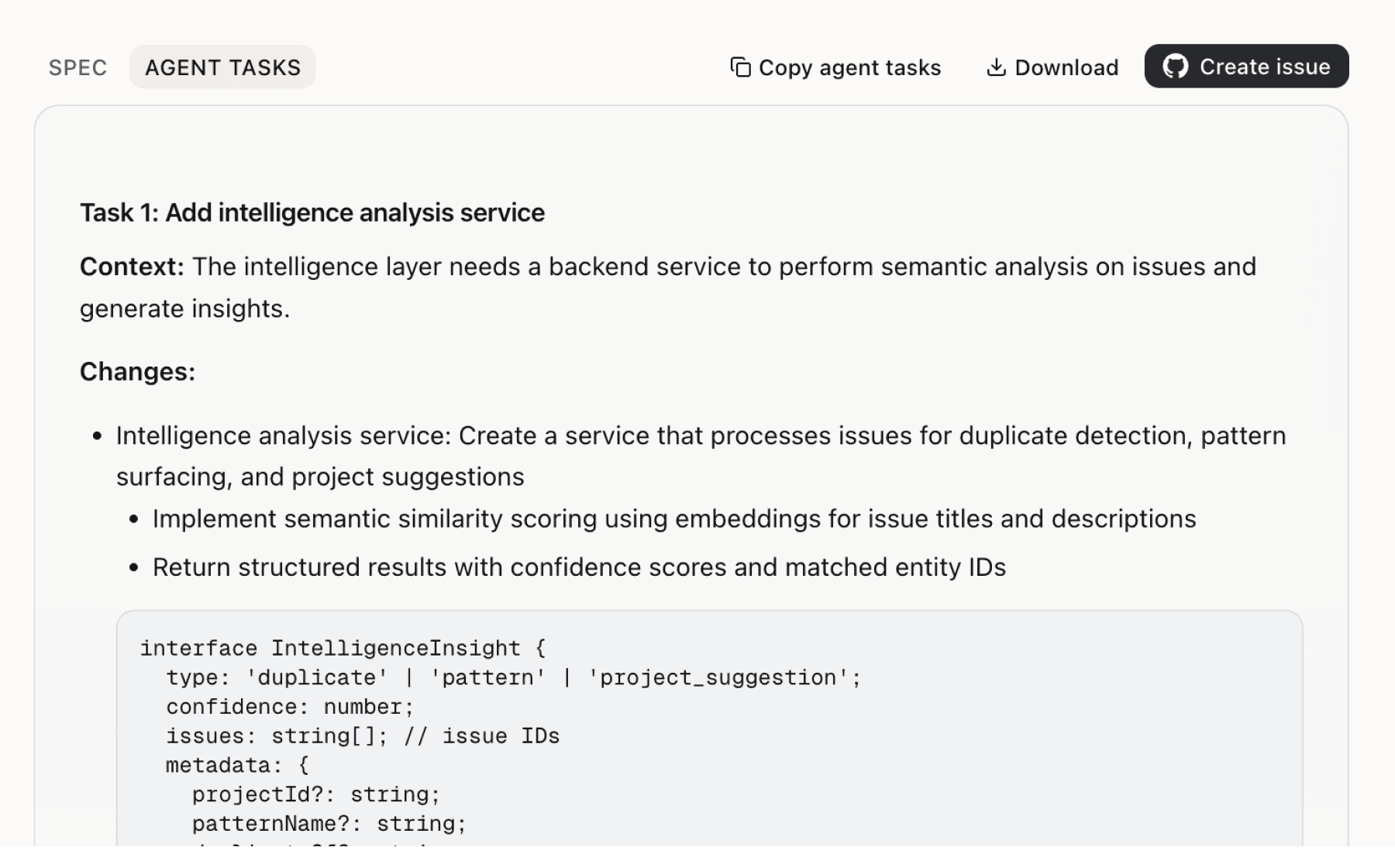
Specs your agents can ship
Go from insight to implementation spec to code-ready tasks in one click.
This analysis used public data only. Imagine what Mimir finds with your customer interviews and product analytics.
Try with your dataMore recommendations
5 additional recommendations generated from the same analysis
Vela users at McKinsey and BCG represent high-value professional networks where word-of-mouth carries exceptional weight. The product already tracks quantifiable time savings, creating natural moments when users feel genuine gratitude and are most likely to recommend. A milestone-triggered referral program captures this energy when it's strongest.
Vela handles individual meeting coordination comprehensively but professionals face another major time drain: managing recurring 1-on-1s, standing team meetings, and quarterly business reviews. These represent predictable scheduling overhead that multiplies the coordination burden. A partner maintaining monthly check-ins with 15 clients faces this same back-and-forth 180 times per year.
Every scheduling negotiation is a demonstration of the problem Vela solves, yet current users don't leverage these moments for organic growth. When a Vela user's contact experiences the third round of "what about Thursday?" emails, they're primed to ask how to eliminate this friction. An email signature line like "Scheduled effortlessly with Vela" or an out-of-office auto-responder mentioning Vela scheduling turns every coordination into a micro-advertisement.
Associates, lawyers, and business development professionals handle specialized meeting types with distinct patterns—discovery calls, client check-ins, pitch meetings, case reviews. Vela currently handles custom meeting preferences but doesn't offer pre-configured templates that match how these segments actually work. A McKinsey associate scheduling a client workshop has different needs than a BD professional booking a prospecting call.
Individual scheduling automation is valuable but partners and directors often coordinate meetings involving multiple team members—case teams, client-facing groups, or project squads. This multiplies the coordination complexity exponentially as availability must align across more calendars. Vela handles multi-attendee meetings but doesn't yet optimize for internal team scheduling where the user needs to coordinate their own colleagues.
Insights
Themes and patterns synthesized from customer feedback
Vela schedules thousands of meetings each week and measures actual time saved post-deployment rather than making fixed claims. This approach demonstrates genuine value delivery to users and provides data to support growth and retention claims.
“Vela schedules thousands of meetings each week across its user base”
Meeting coordination back-and-forth, timezone math, and calendar juggling consume significant hours that professionals never get back. This represents a core pain point that Vela is positioned to solve by returning professionals' most valuable resource: time.
“Meeting coordination back-and-forth, timezone math, and calendar juggling consume significant hours that professionals never get back”
Vela autonomously handles the full spectrum of scheduling coordination tasks—automatically following up, proposing times, booking, rescheduling, and sending confirmations—across Email, SMS, and WhatsApp. This end-to-end automation directly addresses the back-and-forth friction that consumes professional time.
“Vela autonomously handles multiple scheduling tasks: automatically follows up, proposes times, books, reschedules, and sends confirmations”
Run this analysis on your own data
Upload feedback, interviews, or metrics. Get results like these in under 60 seconds.