
What Tensol users actually want
Mimir analyzed 1 public source — app reviews, Reddit threads, forum posts — and surfaced 7 patterns with 5 actionable recommendations.
This is a preview. Mimir does this with your customer interviews, support tickets, and analytics in under 60 seconds.
Top recommendation
AI-generated, ranked by impact and evidence strength
Build proactive alert system that detects and correlates critical bugs within minutes of deployment
High impact · Medium effort
Rationale
Critical bugs currently take 6 hours to be noticed, exposing customers to known issues and creating significant risk. The product already demonstrates this capability — an AI employee caught checkout issues across 3 customers and alerted the team proactively. Engineering teams spend 2 hours understanding bugs that AI connects in 30 seconds by correlating Sentry errors with Linear tickets and git pushes.
This directly addresses the revenue growth goal by reducing customer-facing incidents that damage trust and retention. The infrastructure exists (monitoring 3 Sentry projects, 5 GitHub repos, 2 Linear teams), so the effort is primarily refining detection logic and notification routing. This turns a reactive 6-hour problem into a proactive 5-minute solution.
Prioritizing incident detection over other features maximizes business impact because downtime and bugs directly cost revenue, while the technical foundation is already proven in production.
Projected impact
The full product behind this analysis
Mimir doesn't just analyze — it's a complete product management workflow from feedback to shipped feature.
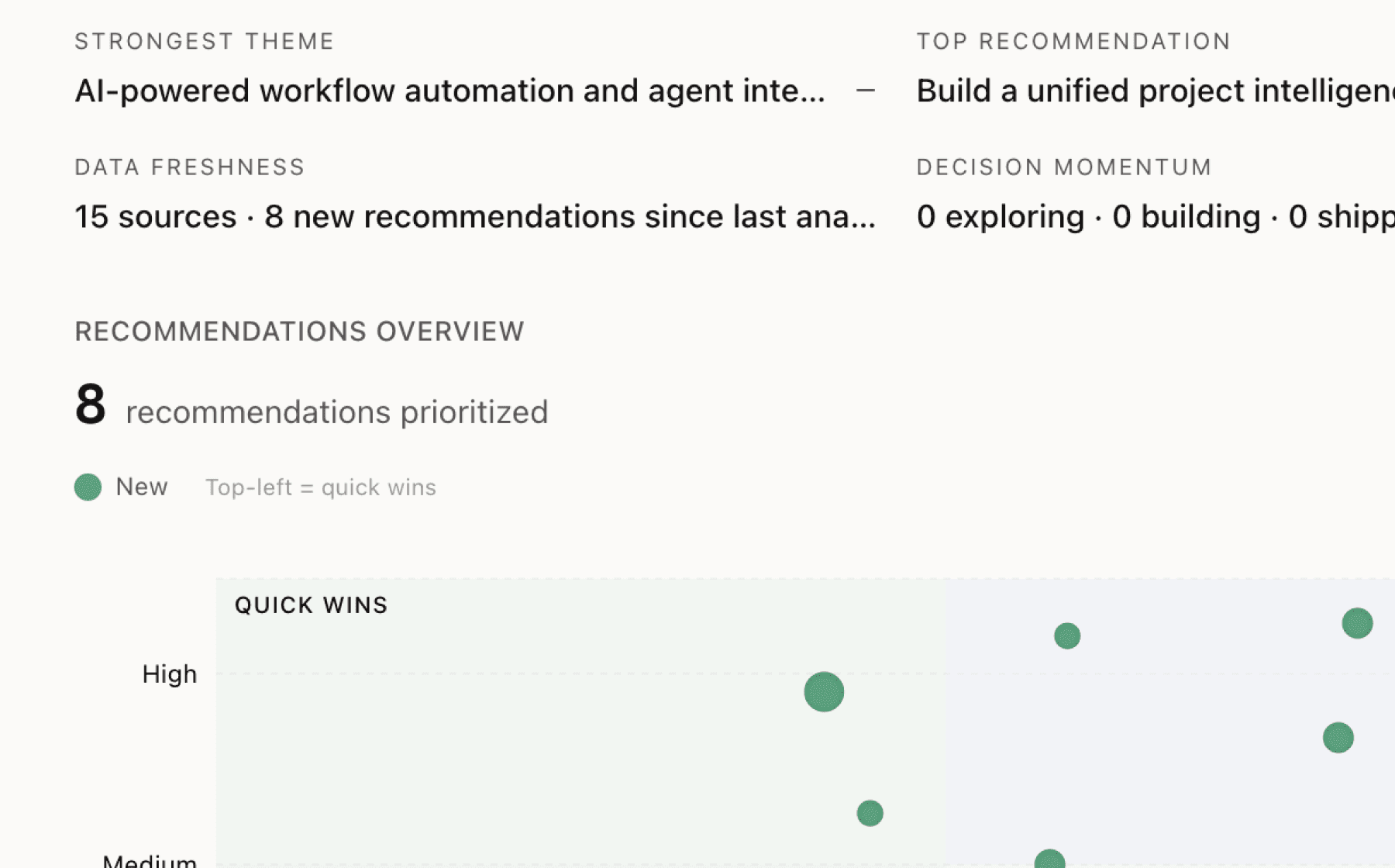
Evidence-backed insights
Every insight traces back to real customer signals. No hunches, no guesses.
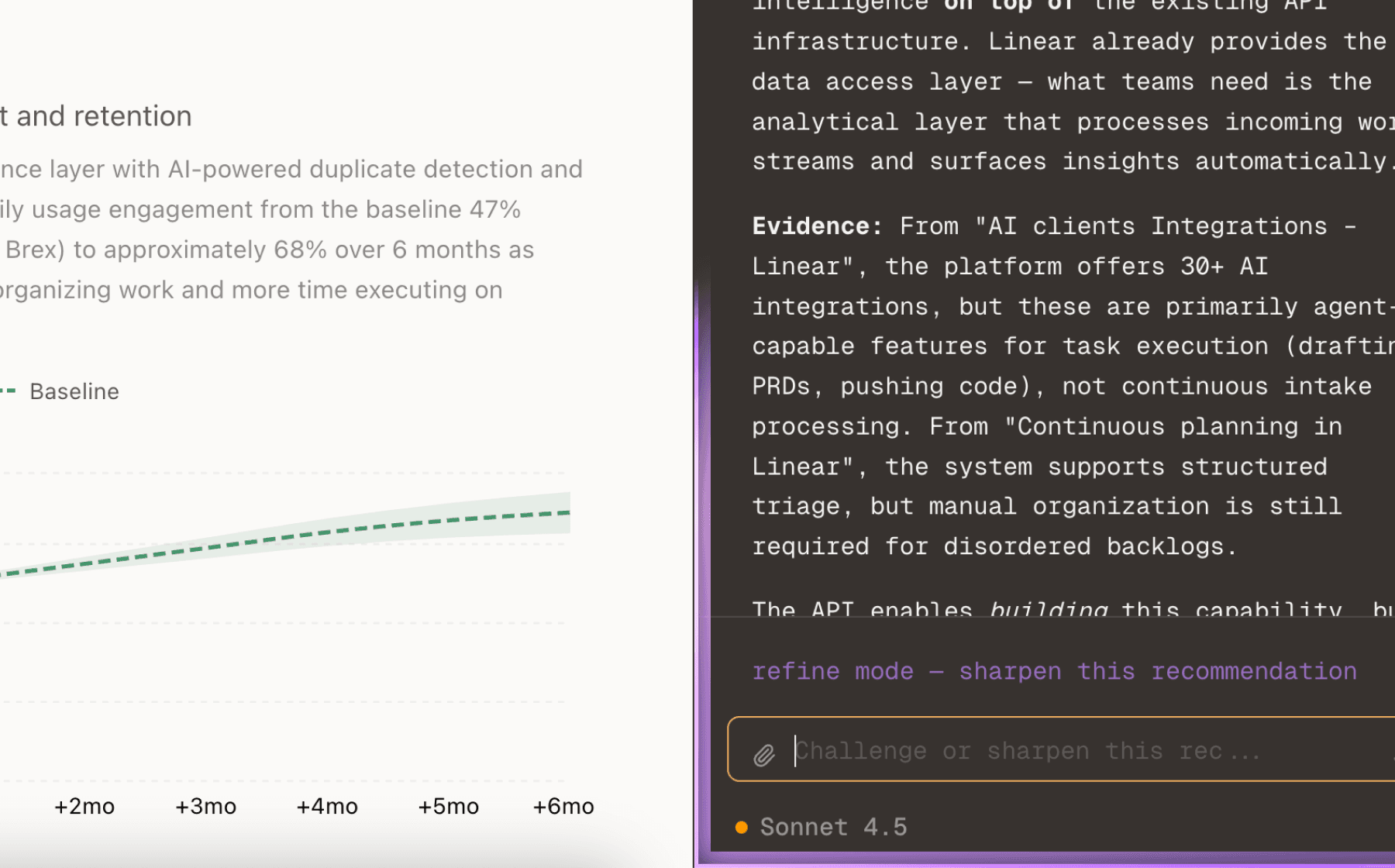
Chat with your data
Ask follow-up questions, refine recommendations, and capture business context through natural conversation.
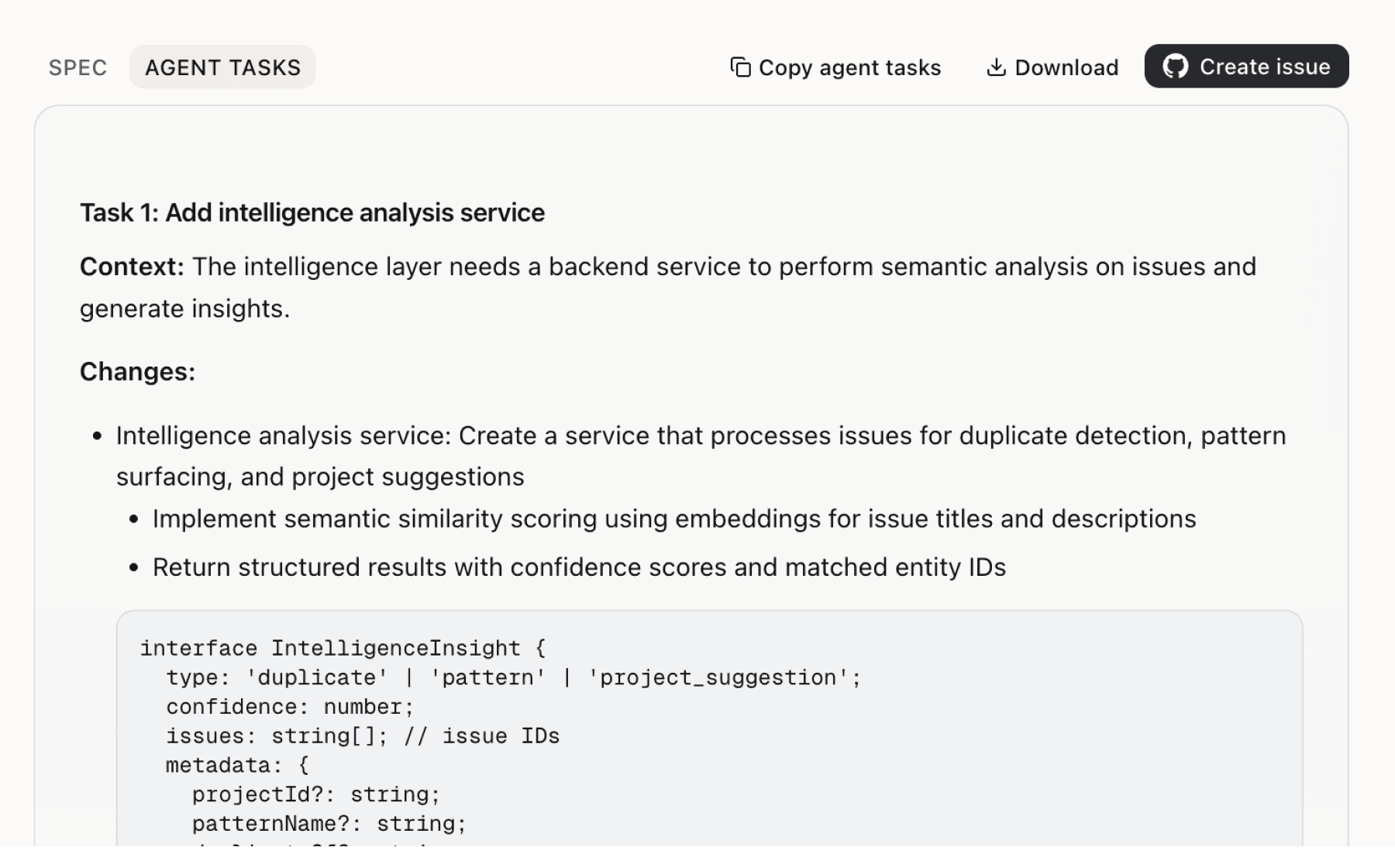
Specs your agents can ship
Go from insight to implementation spec to code-ready tasks in one click.
This analysis used public data only. Imagine what Mimir finds with your customer interviews and product analytics.
Try with your dataMore recommendations
4 additional recommendations generated from the same analysis
Engineers lose 23 minutes per interruption due to context switching and 67% of company context lives undocumented across scattered tools. Teams spend 2 hours understanding bugs when AI can connect the dots in 30 seconds. Support issues slip through cracks because monitoring depends on manual checks across isolated systems.
Call notes never reach CRM because sales reps must manually enter them before prospects hang up, pulling focus from closing deals. This manual step creates friction at the most critical moment in the sales cycle. The product already tracks 142 HubSpot deals and 3 Gmail inboxes, demonstrating the integration exists.
New hire onboarding traditionally takes 2 weeks but AI employees can provide full historical context on Day 1, allowing immediate productivity. This directly addresses team scaling constraints that limit growth velocity. When 67% of company context lives undocumented across tools, new hires face an invisible knowledge gap that slows ramp time.
Setup takes 5 minutes with one-click OAuth and no technical requirements, demonstrating low implementation friction. However, adoption requires trust, especially when AI is updating CRMs, logging calls, and correlating production incidents. A supervised workflow that requires approval before granting autonomy builds trust progressively.
Insights
Themes and patterns synthesized from customer feedback
Setup takes only 5 minutes with one-click OAuth and no technical requirements, allowing all teams to deploy without DevOps overhead. A supervised workflow that requires approval before granting autonomy builds trust progressively.
“Setup takes only 5 minutes with one-click OAuth, no terminal, coding, or DevOps required”
The AI is currently actively monitoring 12 Slack channels, 3 Sentry projects, 5 GitHub repos, 2 Linear teams, 142 HubSpot deals, and 3 Gmail inboxes, demonstrating operational capability and integration breadth in production.
“AI currently monitoring 12 Slack channels, 3 Sentry projects, 5 GitHub repos, 2 Linear teams, 142 HubSpot deals, 3 Gmail inboxes”
Sales teams spend time manually logging call notes and updating deal stages instead of closing deals. Automated CRM updates, email tracking, and deal stage management remove this manual step while ensuring context is fresh for the next interaction.
“For Sales: CRM auto-updates with call notes, email tracking, deal stage management, and follow-up scheduling”
Support issues slip through cracks when monitoring depends on manual checks across scattered tools. The product enables simultaneous monitoring of Slack, GitHub, Sentry, CRM, and email to catch issues immediately rather than waiting for reactive reports.
“Support issues slip through cracks due to scattered tools and manual monitoring”
Traditional onboarding takes 2 weeks, but AI employees provide full historical context on Day 1, allowing new hires to contribute immediately. This reduces the ramp time that typically constrains team scaling.
“New hire onboarding reduced from 2 weeks to Day 1 productivity with full context via AI employee”
Teams lose significant time to context switching and manually hunting information across disconnected tools. With 67% of company context undocumented and spread across multiple systems, engineers spend 2 hours understanding bugs that AI can connect in 30 seconds, and sales reps manually enter call notes instead of focusing on prospects.
“Teams lose 23 minutes refocusing after every interruption due to context switching”
Critical bugs take 6 hours on average to be noticed, leaving customers exposed to known issues. AI monitoring can identify root causes within minutes of deployment, as demonstrated by a recent checkout issue caught across multiple customers.
“Average time before critical bugs get noticed is 6 hours”
Run this analysis on your own data
Upload feedback, interviews, or metrics. Get results like these in under 60 seconds.