What Sylvian users actually want
Mimir analyzed 5 public sources — app reviews, Reddit threads, forum posts — and surfaced 10 patterns with 7 actionable recommendations.
This is a preview. Mimir does this with your customer interviews, support tickets, and analytics in under 60 seconds.
Top recommendation
AI-generated, ranked by impact and evidence strength
Build confidence scoring and accuracy indicators into extraction output
High impact · Medium effort
Rationale
Users must manually review all output because the system provides no accuracy guarantees. This creates friction in the automation workflow and undermines the core value proposition of time savings. Multiple themes reveal the tension between promising automation and requiring manual validation.
Adding per-field confidence scores and flagging low-confidence extractions would allow users to focus review efforts on uncertain data rather than checking everything. This preserves safety while reducing review time by 60-80% for high-confidence extractions.
This change directly impacts engagement and retention by making the product more reliable for business-critical workflows. Users can adopt it faster when they trust the output quality, and the product becomes viable for mission-critical use cases that currently require full manual review.
Projected impact
The full product behind this analysis
Mimir doesn't just analyze — it's a complete product management workflow from feedback to shipped feature.
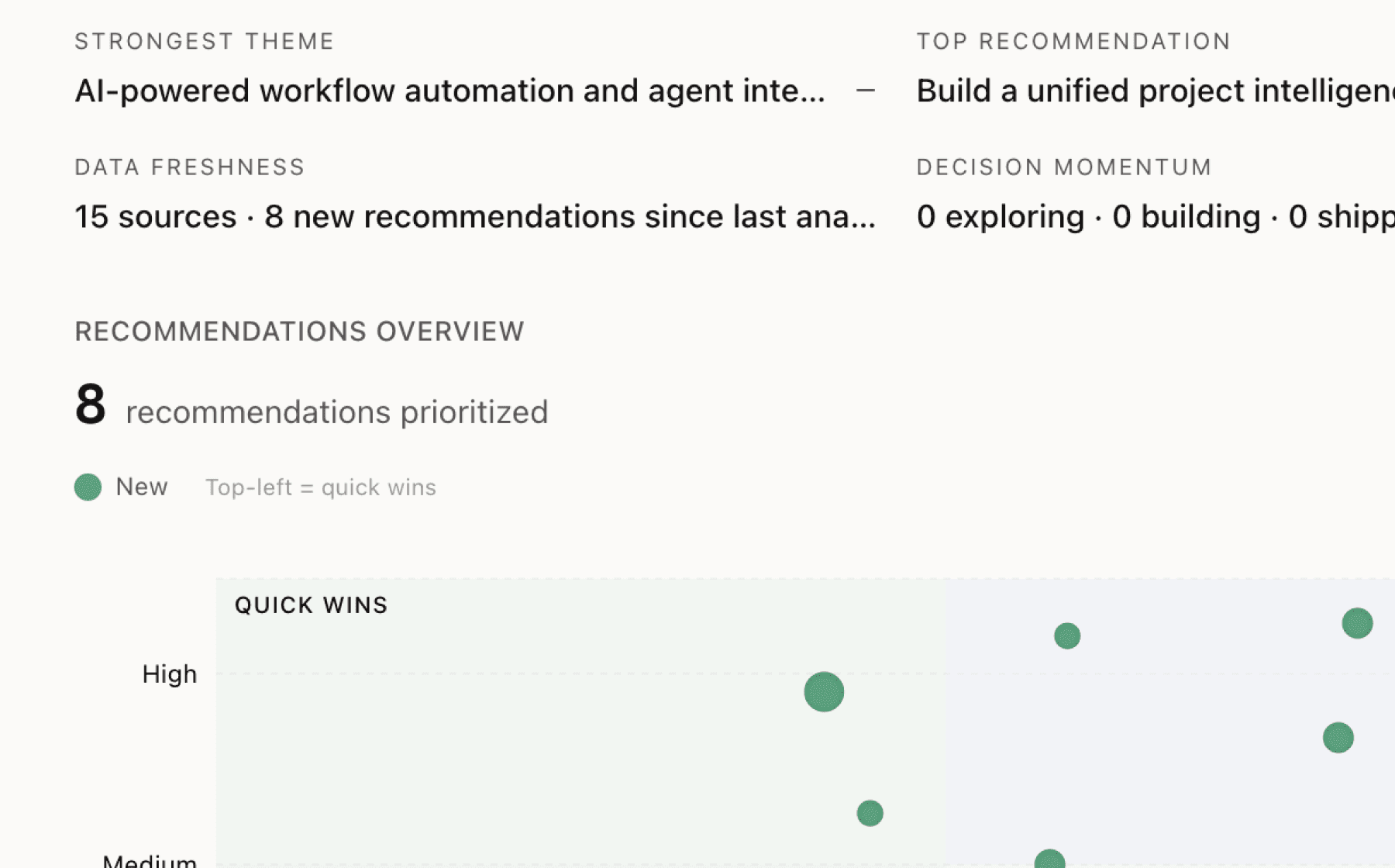
Evidence-backed insights
Every insight traces back to real customer signals. No hunches, no guesses.
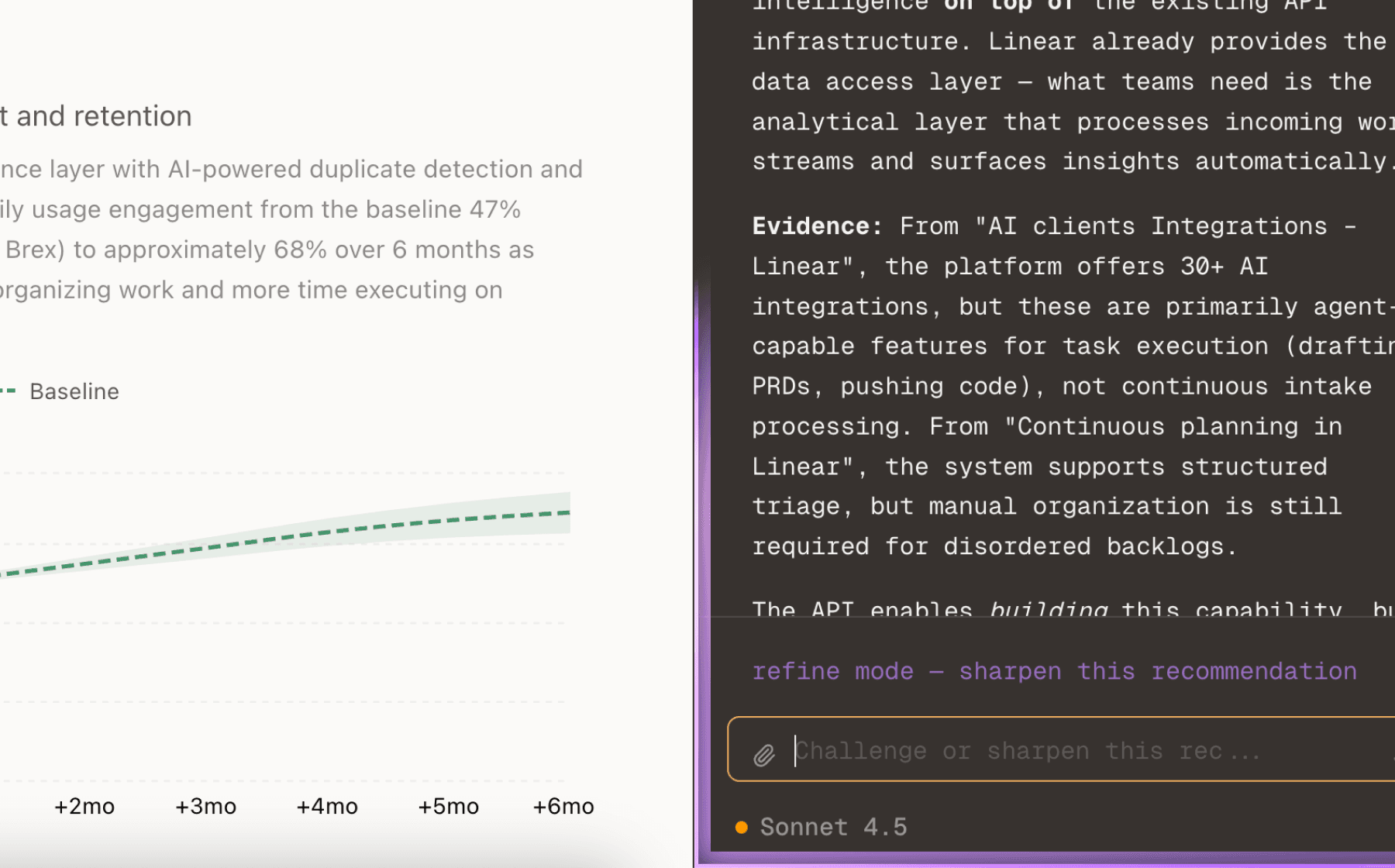
Chat with your data
Ask follow-up questions, refine recommendations, and capture business context through natural conversation.
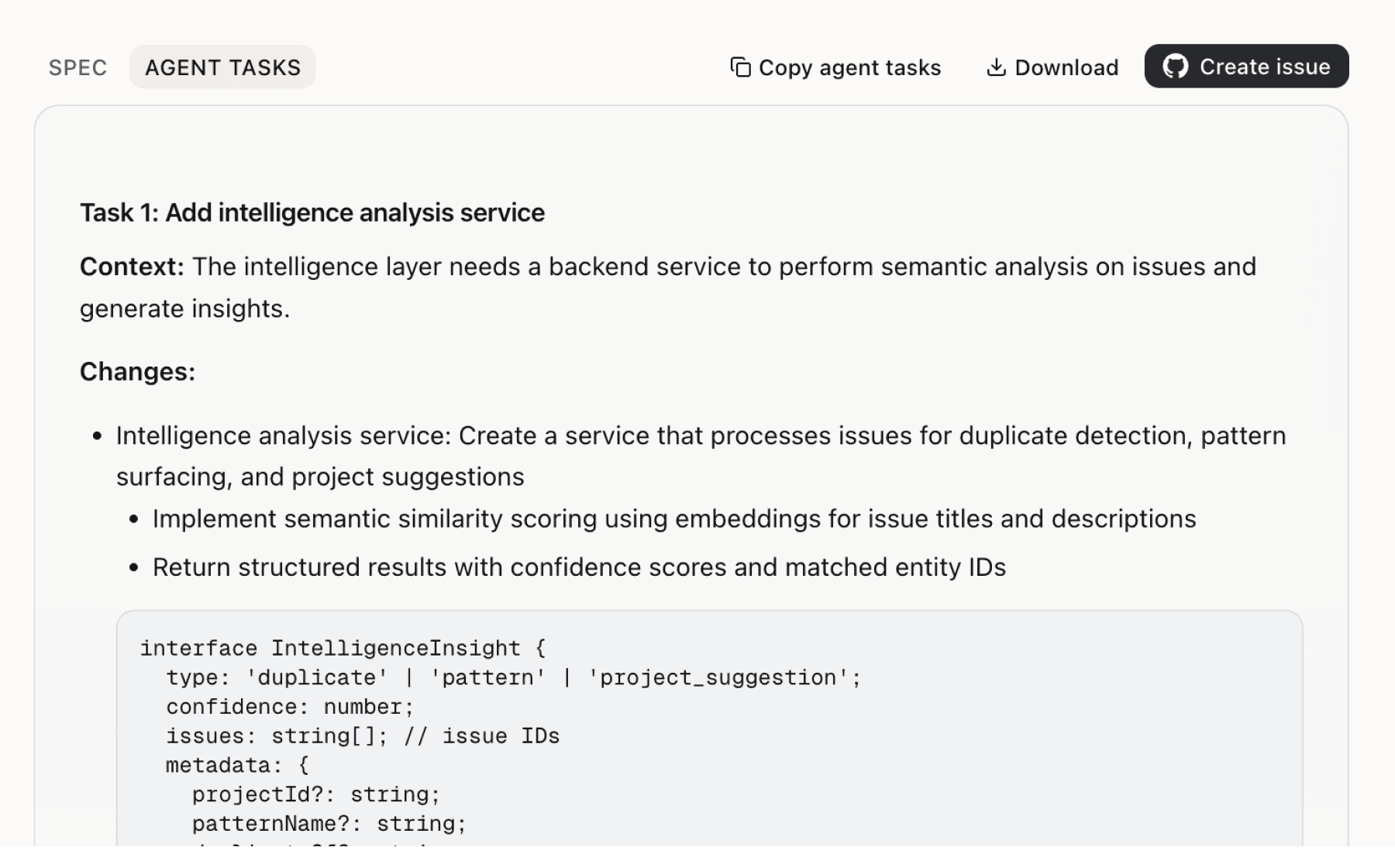
Specs your agents can ship
Go from insight to implementation spec to code-ready tasks in one click.
This analysis used public data only. Imagine what Mimir finds with your customer interviews and product analytics.
Try with your dataMore recommendations
6 additional recommendations generated from the same analysis
The product successfully handles complex forms with 251 fields across diverse field types, but users must review all output due to accuracy concerns. Building domain-specific validation would catch common errors automatically and increase confidence in extraction quality.
Users request personalized demo walkthroughs, and the product targets multiple personas with different evaluation criteria. Engineering leads care about API integration, product managers want workflow automation, operations needs accuracy metrics, and executives focus on ROI. Generic onboarding fails to resonate with any of these groups.
Enterprise users request on-premise deployment and custom AI agents, while current terms allow the company to use uploaded content for product improvement. This creates friction for organizations with sensitive data or competitive concerns about their documents training a shared model.
The freemium-to-enterprise ladder works well for individual adoption, but teams need shared credit pools and usage visibility. Product managers and engineering leads evaluating the product want to see how their team would use it together, not just individual workflows.
Enterprise users evaluate the product for business-critical workflows, but current terms allow the company to withdraw or amend services without notice and cap liability at $400 or 12-month payments. This creates hesitation for users considering the product for mission-critical form processing.
Enterprise users request custom AI agents, but the current model requires dedicated support and custom development. This creates long sales cycles and limits how many custom solutions the team can deliver.
Insights
Themes and patterns synthesized from customer feedback
Product offers a clear pricing progression: free tier (10 credits), Pro ($30/month with 500 credits), and Enterprise (unlimited pages). Pay-as-you-go overage pricing at $0.10 per credit encourages usage expansion and reduces barriers to initial adoption.
“Freemium pricing model with 10 credits on free trial, 500 credits/month on Pro ($30/month), and unlimited pages on Enterprise”
Company reserves the right to withdraw, terminate, or amend services without notice, and caps liability at $400 or 12-month payment amount. These broad terms may create hesitation for users evaluating the product for business-critical workflows.
“Company reserves right to withdraw, terminate, or amend Services without notice at sole discretion”
Sylvian supports industry-specific form workflows beyond healthcare, positioning itself as a cross-sector solution. This broad applicability opens multiple vertical markets but may require industry-specific customization and validation.
“Product supports industry-specific form workflows across healthcare, government, legal, and finance sectors with both parsing and filling capabilities”
Sylvian reduces acquisition friction through free trial access and demo requests, enabling users to evaluate the product before commitment. This lowers the barrier to testing the product's effectiveness on real workflows.
“Product offers free trial and demo request options to reduce user acquisition friction and allow low-risk evaluation”
Product targets engineering leads, product managers, operations, and executives with different needs. Success requires tailored messaging and features for each persona to drive engagement and retention across the user base.
“Sylvian targets multiple user personas: engineering leads, product managers, operations, and executives”
User-uploaded content is licensed to the company for service provision and product improvement, but users cannot use Sylvian output to train competing ML models. This creates potential friction for enterprise users concerned about competitive use of their data.
“User-uploaded content (PDFs, documents, images) is licensed to company for service provision and product improvement”
Users across product manager, founder, and engineering lead personas request personalized demo walkthroughs and enterprise-grade features including custom AI agents, on-premise deployment, and dedicated support. This indicates demand for tailored solutions beyond the base product.
“Personalized demo walkthrough to showcase PDF workflow automation capabilities”
Sylvian successfully parses complex forms like CMS-1500 with 251 fields across multiple pages containing diverse field types (radio buttons, text inputs, dates, multi-line service items). This demonstrates core capability but also highlights the complexity users need automated.
“Sylvian demonstrates capability to parse and extract complex healthcare forms, specifically the CMS-1500 insurance claim form with 251 fields across 2 pages”
Documents are processed in isolated, encrypted environments and deleted immediately after processing unless users opt for extended storage. This addresses enterprise security concerns but requires clear communication about the data handling model to build user trust.
“Your documents are processed in secure, isolated environments with encryption in transit and at rest”
Sylvian provides no guarantee of accuracy or completeness in extracted data and filled forms, requiring users to review all output before use. This creates friction in the automation workflow and impacts the reliability of the product for mission-critical form processing.
“Service output (extracted data, filled forms) is provided 'as-is' with no guarantee of accuracy, completeness, or error-free results”
Run this analysis on your own data
Upload feedback, interviews, or metrics. Get results like these in under 60 seconds.