
What Sonarly users actually want
Mimir analyzed 2 public sources — app reviews, Reddit threads, forum posts — and surfaced 11 patterns with 7 actionable recommendations.
This is a preview. Mimir does this with your customer interviews, support tickets, and analytics in under 60 seconds.
Top recommendation
AI-generated, ranked by impact and evidence strength
Build a viral loop into the free tier by enabling project invites with visibility into time saved
High impact · Medium effort
Rationale
The free tier already removes friction with no credit card and includes AI root cause analysis, but it's limited to 1 project and 50 issues. This creates a structural barrier to viral growth — users can't bring teammates onto their free projects to experience the value together. Since the primary metric is new user adoption and the open question is growing faster, the highest-leverage move is turning happy free users into acquisition channels.
The evidence shows resolution speed is the core value prop (10x faster, alert to PR in minutes). If free tier users could invite 2-3 teammates to a shared project and see a collaborative dashboard showing cumulative time saved across the team, they'd naturally want to expand usage. The current model forces individual developers to experience value alone, then hit a wall. Instead, let them bring colleagues in, create social proof through shared wins, and convert groups rather than individuals.
This addresses the conversion challenge in Theme 0 while amplifying the speed differentiation in Theme 2. When a team sees "You've collectively saved 47 hours this month" they'll advocate internally for paid expansion. The free tier becomes a growth engine, not just a trial.
Projected impact
Implementation spec
The full product behind this analysis
Mimir doesn't just analyze — it's a complete product management workflow from feedback to shipped feature.
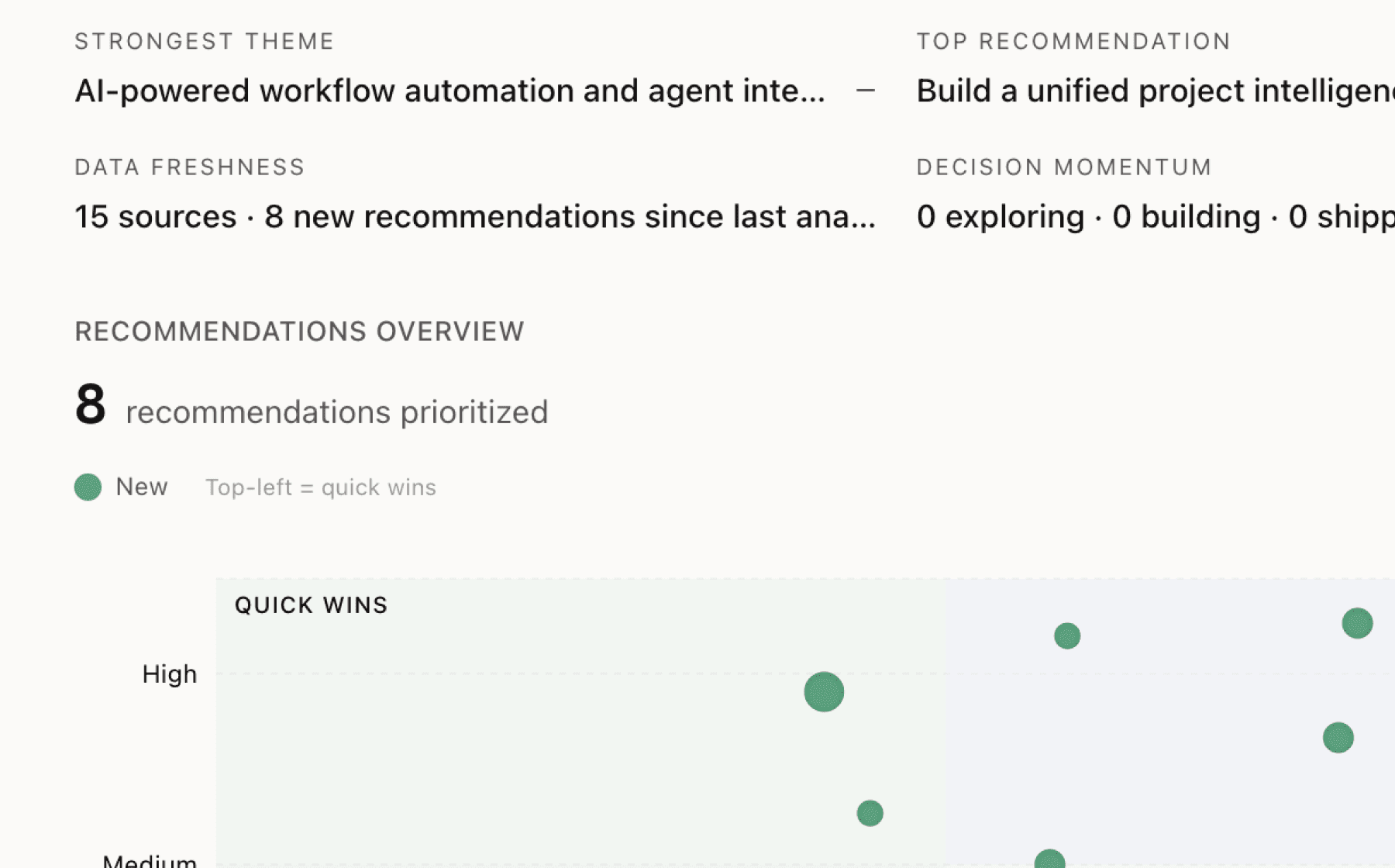
Evidence-backed insights
Every insight traces back to real customer signals. No hunches, no guesses.
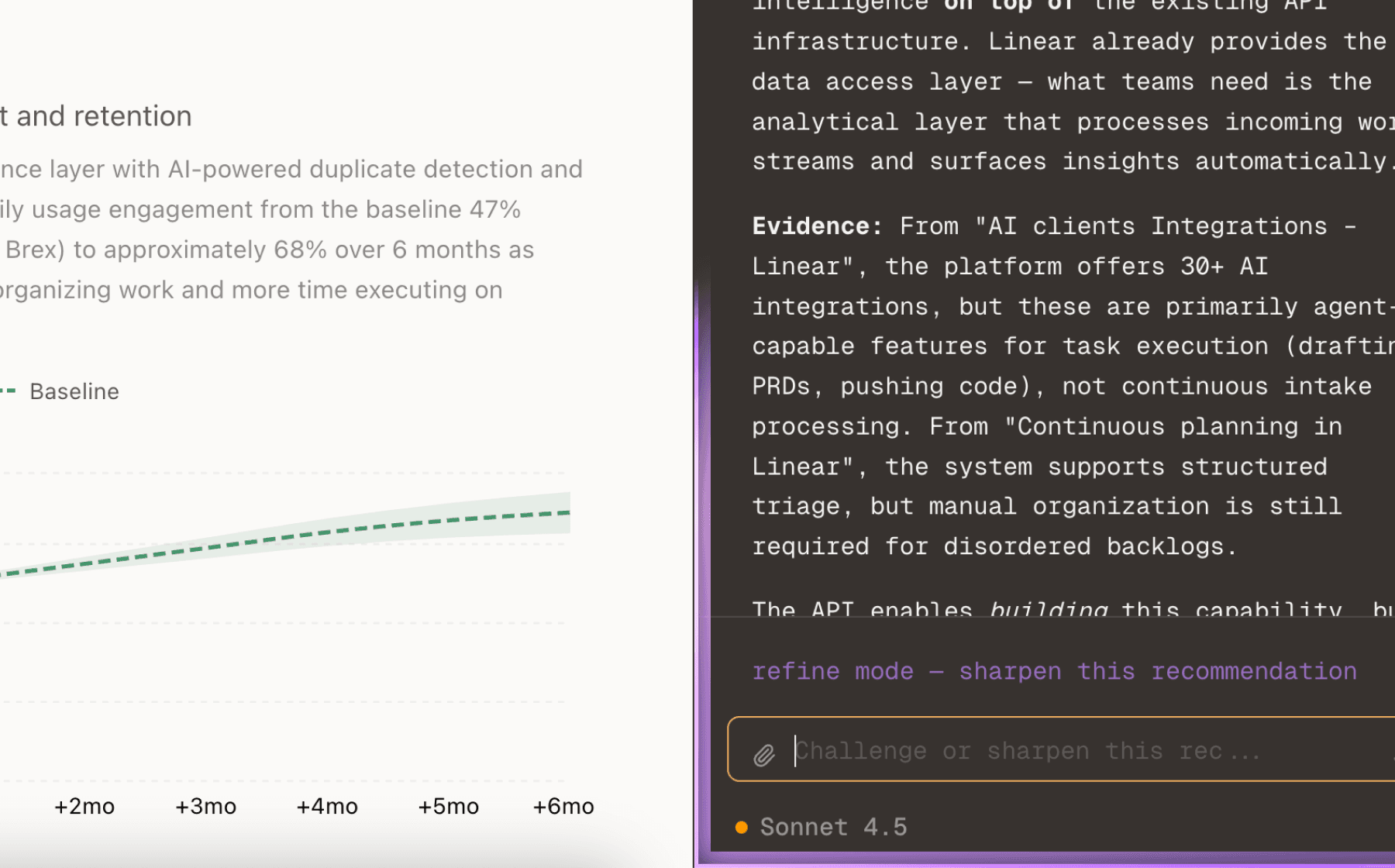
Chat with your data
Ask follow-up questions, refine recommendations, and capture business context through natural conversation.
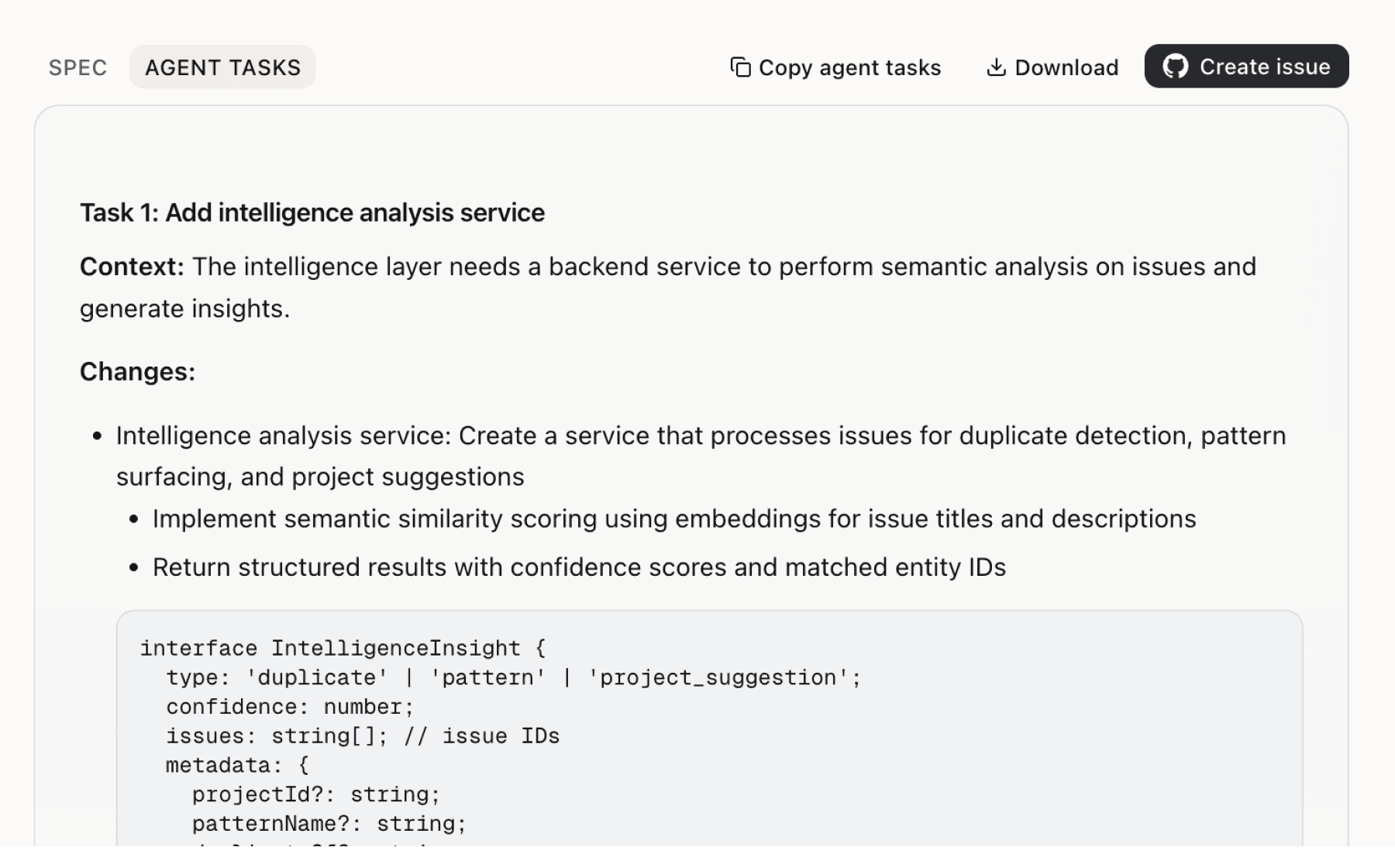
Specs your agents can ship
Go from insight to implementation spec to code-ready tasks in one click.
This analysis used public data only. Imagine what Mimir finds with your customer interviews and product analytics.
Try with your dataMore recommendations
6 additional recommendations generated from the same analysis
Engineers evaluating Sonarly need to viscerally understand the 10x resolution speed claim, but the current flow requires them to wait for real errors and manually compare. The first-run experience is critical for new user adoption — if someone doesn't see clear value in their first session, they churn before the product has a chance to prove itself.
The current product focuses on individual engineer workflows, but the buying decision for Pro tier expansion often happens at the team or engineering manager level. Decision-makers need to see team-wide impact to justify budget, especially for a custom-priced Pro tier. Right now there's no clear way for a manager to quantify Sonarly's ROI across their team's on-call rotation.
The autonomous PR feature is a key differentiator (Theme 5), but engineers are often hesitant to merge AI-generated code without validation. This creates friction in the workflow — the PR gets opened, but then engineers still need to manually review, test, and validate before merging. The promise of "alert to resolution" stalls at "alert to PR" because trust hasn't been established.
Engineering teams using Sonarly already benefit from internal alert triage, but they're still manually updating status pages when blocking issues affect users. Theme 3 shows Sonarly already classifies severity (Blocking, Annoying, Harmless) with good accuracy. If Blocking issues could automatically trigger status page updates via integrations with Statuspage, Atlassian, or similar tools, it closes another manual step in the incident response workflow.
Theme 4 shows Sonarly integrates with major platforms (Sentry, Datadog, PagerDuty, etc.), but each integration requires manual configuration of alert rules, severity thresholds, and filtering logic. This creates setup friction that delays time-to-value, especially for new users evaluating the product. If someone connects Sentry but then has to spend 30 minutes configuring rules before seeing any benefit, they may abandon before experiencing the core value.
Engineers using Sonarly still context-switch between their observability tools (Sentry, Datadog) and Sonarly's interface. Theme 1 identifies context switching as a major friction point in on-call workflows. Even though Sonarly provides better triage and analysis, engineers often start their investigation in Sentry because that's where the alert originates, then have to navigate to Sonarly to see the AI analysis.
Insights
Themes and patterns synthesized from customer feedback
Sonarly can import 100+ issues at once in 1-5 minutes, enabling efficient handling of teams with high error volume in production environments. This capability is important for teams shipping fast and dealing with significant alert load.
“Automatic import fetches latest 100+ issues at once”
Sonarly is backed by Y Combinator, which signals institutional validation and provides access to mentorship, network, and credibility benefits. This is relevant to user trust and market positioning.
“Sonarly is backed by Y Combinator, indicating institutional validation and support”
Sonarly is SOC 2 compliant and implements industry-standard encryption (Fernet/AES) with automatic token refresh. This addresses security and compliance requirements for enterprise adoption.
“All OAuth tokens are encrypted at rest using industry-standard Fernet (AES) with automatic refresh before expiry”
Sonarly provides Slack integration with configurable digest frequencies (24h, 12h, 6h, 1h) and rich message formatting that shows severity, occurrence count, and direct links. This enables engineers to receive alerts in their primary communication tool with appropriate batching to reduce notification fatigue.
“Slack integration provides configurable delivery (24h, 12h, 6h, 1h digests) with rich messages showing bug severity, occurrence count, and direct links”
Sonarly's incident response capability captures context, queries logs, analyzes root causes, and generates detailed incident reports with timelines and suggested actions. This feature extends the product beyond error monitoring into broader incident management and post-mortems.
“Incident Response feature captures incident context, queries logs, analyzes root cause, generates detailed incident report with timeline and suggested actions”
Sonarly removes signup friction with no credit card required and includes AI-powered root cause analysis in the free tier, targeting individual developers and side projects. The free tier includes meaningful features but is capped at 1 project and 50 issues/month to funnel users toward the Pro tier for production teams.
“No credit card required for free tier signup - removes friction for user acquisition”
Sonarly uses a three-tier deduplication approach (ID match, message fingerprint, semantic AI) and automatically classifies bugs by severity (Blocking, Annoying, Harmless) to reduce noise and help engineers prioritize. This directly addresses the alert noise problem and improves the signal-to-noise ratio in on-call workflows.
“Smart deduplication uses 3-tier approach: ID match (instant), message fingerprint (fast), semantic AI (smart)”
Sonarly's AI code analysis automatically explores the codebase, identifies root causes, generates fixes, and creates pull requests without manual intervention. This autonomous capability is a core feature that differentiates the product and directly contributes to the 10x resolution time improvement.
“Autonomous PR generation: agent investigates codebase, finds fixes, and opens PRs without manual intervention”
Sonarly integrates with major observability and incident management platforms (Sentry, Datadog, Slack, GitHub, Bugsnag, PagerDuty) and recent updates include observability agents for CloudWatch analysis. These integrations reduce setup friction and allow Sonarly to work within existing engineering workflows.
“Integrated with major observability platforms: Sentry, Datadog, Slack, GitHub, Bugsnag, PagerDuty”
Sonarly's core value proposition centers on cutting resolution time by 10x, with the ability to go from alert to PR in minutes through autonomous code analysis and fix generation. This speed advantage is fundamental to the product's positioning and directly addresses engineer pain around on-call burden.
“Primary value proposition: cut resolution time by 10x”
Engineers waste significant time manually triaging alerts, switching contexts between tools, and dealing with duplicates and false positives. This directly impacts alert response speed and engineer productivity during on-call rotations. Sonarly addresses this by automating triage, deduplication, and severity classification to reduce manual work.
“Users experience manual triage and context switching when handling alerts”
Run this analysis on your own data
Upload feedback, interviews, or metrics. Get results like these in under 60 seconds.