What GovDash users actually want
Mimir analyzed 15 public sources — app reviews, Reddit threads, forum posts — and surfaced 15 patterns with 8 actionable recommendations.
This is a preview. Mimir does this with your customer interviews, support tickets, and analytics in under 60 seconds.
Top recommendation
AI-generated, ranked by impact and evidence strength
Build compliance verification layer that validates outputs against FAR/DFARS rules in real time
High impact · Large effort
Rationale
Generic AI hallucinations and compliance failures cause immediate disqualification in the zero-tolerance federal evaluation environment. Teams spend more time fixing AI mistakes than they save in drafting, creating a false economy that erodes trust and retention. Thirty-one sources confirm that government-specific AI prevents compliance failure, and users explicitly need verification mechanisms that check output against strict government standards and cross-reference technical approaches with evaluation criteria.
GovDash's purpose-built compliance engine with integrated FAR, CUI, and CMMC checks is the core differentiator against ChatGPT and general-purpose tools, but users still report FAR compliance errors tanking proposal evaluations. The platform should surface compliance violations as they occur during drafting, not just at review gates, and provide inline guidance to fix issues before they compound.
This recommendation directly impacts user engagement by reducing friction in the proposal workflow and increasing confidence in AI-generated content. Users who trust the compliance layer will adopt more aggressively across modules, driving cross-product stickiness and reducing churn risk among top 100 government contractors where compliance is table stakes.
Projected impact
The full product behind this analysis
Mimir doesn't just analyze — it's a complete product management workflow from feedback to shipped feature.
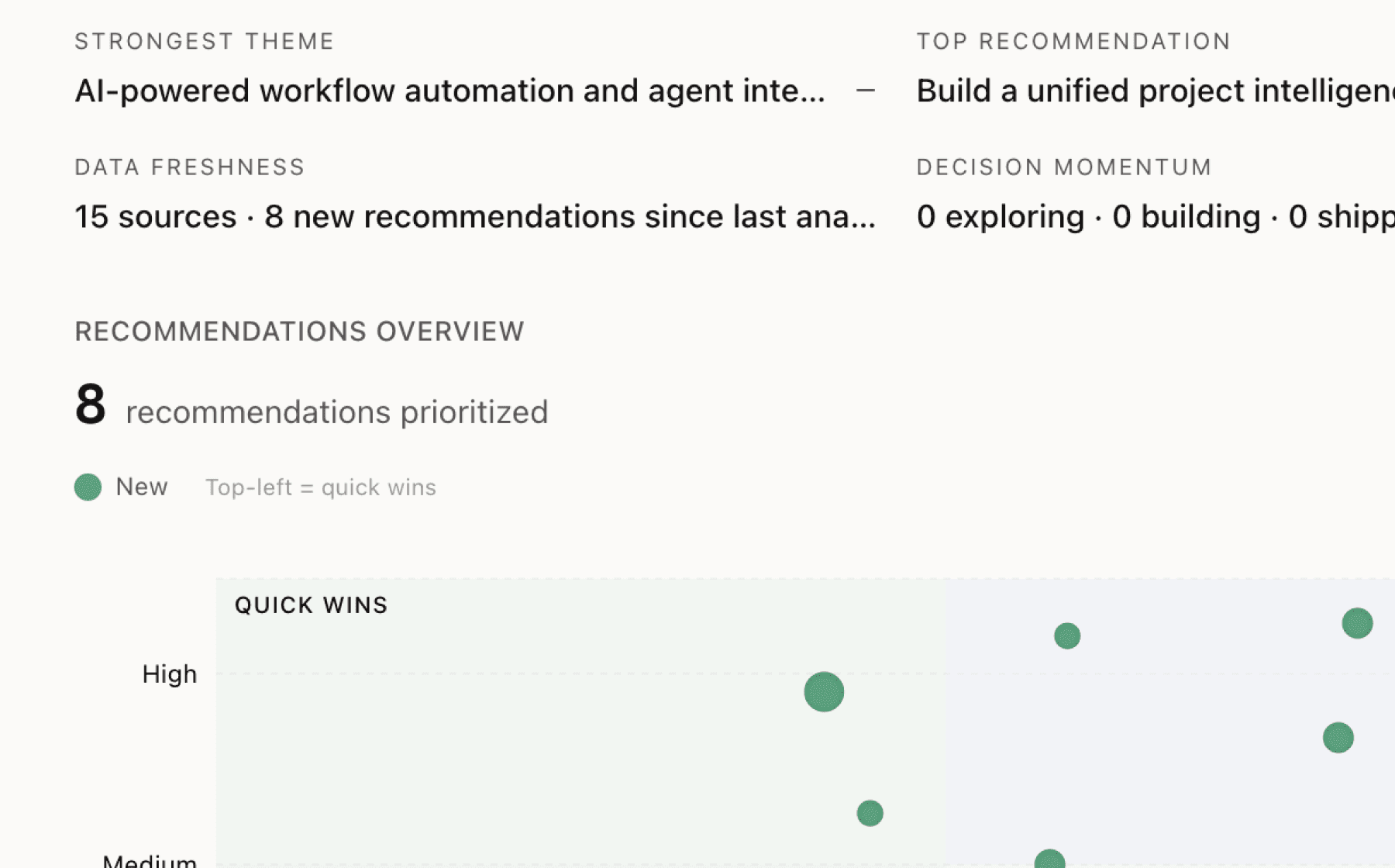
Evidence-backed insights
Every insight traces back to real customer signals. No hunches, no guesses.
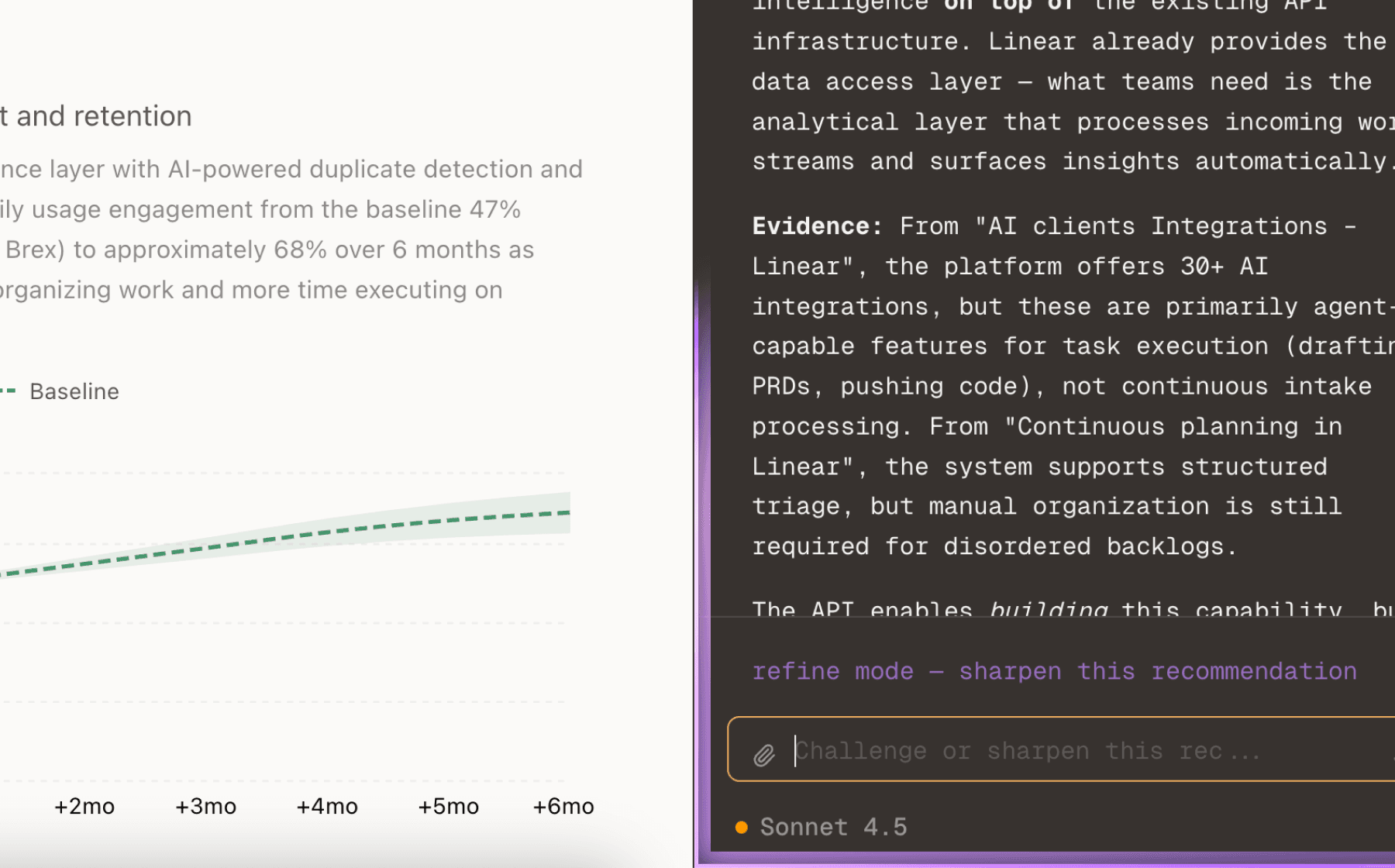
Chat with your data
Ask follow-up questions, refine recommendations, and capture business context through natural conversation.
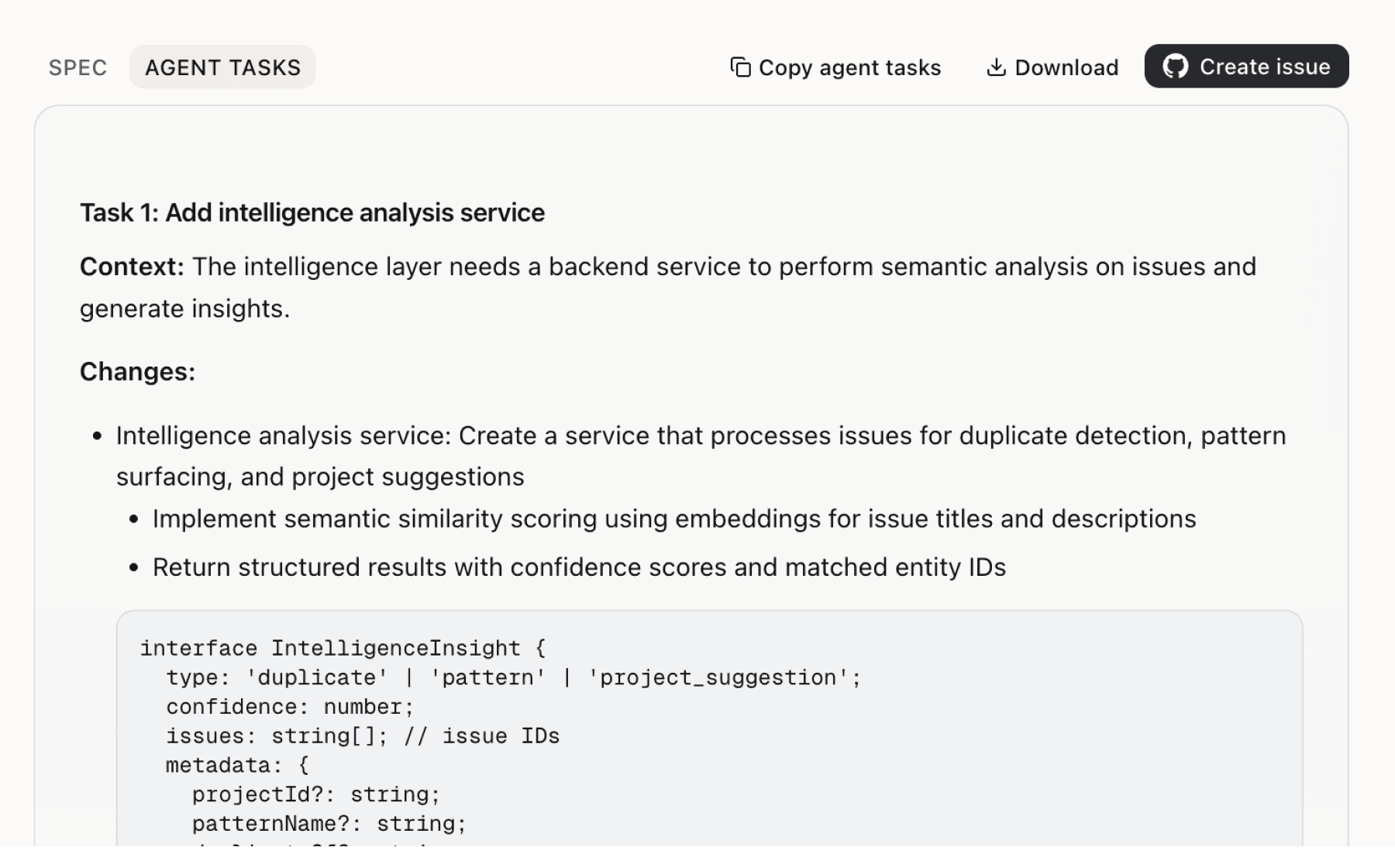
Specs your agents can ship
Go from insight to implementation spec to code-ready tasks in one click.
This analysis used public data only. Imagine what Mimir finds with your customer interviews and product analytics.
Try with your dataMore recommendations
7 additional recommendations generated from the same analysis
FedRAMP Moderate certification with CUI support unlocks enterprise adoption among top 100 government contractors and defense environments, but twenty-eight sources indicate this capability remains underutilized in market positioning. GovDash achieved FedRAMP equivalency in Q1 2026, yet competitors lack this or retrofit security inadequately, creating a decisive competitive window.
Users juggle disconnected tools across opportunity discovery, capture, proposals, and contracts, creating data silos and manual re-upload friction. Eighteen sources confirm that GovDash's unified platform with shared data model across modules eliminates fragmentation, but the current architecture does not fully exploit the compounding value of cross-module context.
Federal solicitations span 50-100+ pages with complex hierarchies across Sections C, L, and M, yet generic AI tools fail to parse these structures and lose relationships between scattered components. Users explicitly need AI that creates requirement traceability matrices automatically to link solicitation requirements to response sections, a capability that standard LLMs lack.
DOD AI-first strategy, NDAA FY26 Commercial Solutions Openings expansion, and FY26 funding approvals create compressed award timelines and urgency for contractors to mobilize. Users report 150% increases in weekly opportunity identification, yet twelve sources indicate that strategic awareness of regulatory changes and funding surges remains fragmented across intel briefs and external research.
Structured color team collaboration produces more competitive proposals and builds institutional knowledge for future pursuits, yet fourteen sources indicate that competitor platforms lack built-in compliance matrices and document traceability. GovDash delivers 50% reductions in pink team draft cycles, but users still rely on external tools for version control and review tracking.
Green team reviews focus on pricing, cost realism, and alignment between pricing strategy and technical solution, yet current roadmap coverage of pricing intelligence remains limited. Army MAPS acquisition signals zero tolerance CPARS policy where one marginal rating could disqualify contractors, creating urgency for users to validate pricing proposals against past performance risk.
Competitor onboarding is lengthy and requires custom training data, while GovDash offers guided ProTeam expert onboarding. Users achieve 60-80% reductions in proposal response time with AI-powered features, yet time-to-value depends on users understanding how to leverage compliance checks, requirement traceability, and structured workflows from day one.
Insights
Themes and patterns synthesized from customer feedback
GovDash is deepening product coverage across Discover, Capture, Proposal, Pricing, and Contract modules with roadmap initiatives for enhanced teaming partner support, configurable outline templates, and pricing intelligence. Roadmap expansion from win strategy into full enterprise resource planning for government contractors creates opportunities for increased engagement.
“Deepen products across Discover, Capture, Proposal, Pricing, and Contract modules”
Pink team reviews at 20-25% completion catch structural and compliance issues early, preventing expensive downstream rework. GovDash's 50% reduction in pink team draft time enables faster iteration and higher-quality submissions before escalation to red and gold team reviews.
“Pink team reviews catch issues before writing progresses too far, preventing costly rework in later stages.”
Budget instability and government shutdown risk may freeze new contract awards in the near term, with major GWACs and procurement decisions delayed (e.g., $50B CIO-SP4 GWAC). GovDash must focus retention efforts and help customers navigate prolonged evaluations and pipeline delays while waiting for market stabilization.
“Budget instability and risk of government shutdown may freeze new contract awards, posing near-term pipeline risk”
Major recompetes and new contract vehicles ($7B USAF CFT, $7.8B SSA IT, $75B Alliant 3) attract all-tier competition in highly competitive task order environments. High stakes and increased participation from Tier 1 competitors elevate the importance of proposal quality, compliance accuracy, and competitive strategy.
“USAF CFT contract: $7B spread across 23 winners, creating highly competitive task order chase”
Some enterprise customers require self-hosted or on-premises deployment options with full isolation from cloud environments, and flexible CUI tagging with customizable data governance to meet organizational security policies. Deployment optionality addresses specific customer requirements for data sovereignty.
“Flexible deployment options including self-hosted/on-premises deployment with full isolation from GovDash cloud environment”
Competitor platforms require lengthy onboarding or custom training data setup, creating friction for product managers and engineering leads. GovDash's ProTeam expert onboarding model accelerates adoption and reduces implementation barriers, enabling faster realization of platform value.
“Competitor onboarding is lengthy or requires custom training data, vs. GovDash's guided ProTeam expert onboarding”
2025 government shutdowns and operational disruptions forced teams to maintain productivity without additional headcount. Platform enables lean teams to manage full proposal lifecycle from discovery through delivery, maintaining continuity during external disruptions.
“2025 government shutdowns and operational disruptions forced teams to maintain productivity without adding headcount”
GovDash has expanded customer count, increased opportunity pursuits per user, and achieved adoption among top 100 U.S. government contractors with demonstrated cross-module engagement (users adopt 2+ modules). Series B funding and measurable contract awards indicate strong product-market fit and retention potential in the $8.6B federal AI market.
“AI market projected at $8.6B for federal government FY26-28, making it the fastest-growing fed segment”
Effective government contracting requires structured color team collaboration (pink, red, gold), requirement traceability matrices, version control, and change tracking—processes that build institutional knowledge and competitive advantage. Competitor platforms lack built-in compliance matrices and document traceability, forcing manual FAR compliance and creating errors; GovDash embeds these controls into workflow.
“Competitor onboarding is lengthy or requires custom training data, vs. GovDash's guided ProTeam expert onboarding”
FAR Part 19 overhaul, GWAC/IDIQ protest trends, CJADC2 adoption, DOD priority shifts to Key Operating Priorities, and movement away from lowest-price staffing toward automation-based solutions fundamentally reshape how contractors compete and which vendors remain relevant. Strategic awareness of these market changes is critical for opportunity identification and pipeline planning.
“Multiple GWAC and IDIQ protests creating delays and uncertainty in pipeline planning across CIO-SP4, OASIS+, NGA CLOVER contracts”
DOD AI-first strategy, NDAA FY26 Commercial Solutions Openings expansion, and FY26 funding approvals ($155B DHS/DOD surge, $151B MDA SHIELD, $10B AFRL AMAC IDIQ) create compressed award timelines and urgency for contractors to mobilize. GovDash is positioned to capitalize on this opportunity window with Series B resources to accelerate discovery-to-win cycles.
“DOD directing AI-first strategy across military operations, creating policy opportunity for AI tool adoption”
Federal contracting demands AI that understands RFP hierarchies, distinguishes Performance Work Statement components, maintains requirement traceability, and ensures FAR/DFARS compliance—capabilities generic AI lacks. GovDash's purpose-built compliance engine with integrated FAR, CUI, and CMMC checks addresses the zero-tolerance environment where evaluators allow no room for error, directly differentiating against ChatGPT and general-purpose tools that hallucinate and introduce disqualification risk.
“Early AI models couldn't reliably execute GovCon workflows end-to-end due to length, intricacy, and compliance requirements”
FedRAMP Moderate certification with CUI support, multi-factor authentication, and role-based access controls are now table stakes for serving top 100 government contractors and accessing defense/civilian environments. GovDash's security-by-design architecture meets mandatory federal data residency, CMMC, and ITAR compliance requirements that competitors either lack or retrofit inadequately.
“GovDash achieved FedRAMP Moderate equivalent compliance without direct federal agency sponsorship by following DoD's equivalency process”
Users juggle disconnected tools and spreadsheets across opportunity discovery, capture, proposals, contracts, and operations—a fragmented workflow that compounds errors and delays. GovDash's integrated end-to-end system with shared data model across Discover, Capture, Proposal, and Contract modules eliminates manual re-uploads and data silos, creating cross-module stickiness and compounding value.
“Platform offers unified AI system covering opportunity discovery, capture, proposals, contracts, and operations”
GovDash delivers quantifiable efficiency improvements including 60-80% reductions in proposal response time, 50% cuts in pink team draft cycles, 90% draft turnaround reduction, and 150% increases in weekly opportunity identification. These gains directly translate to competitive advantage in fast-moving government contract environments where 30-60-90 day award windows are standard.
“Proposals generated 60% faster with AI-powered writing and compliance features”
Run this analysis on your own data
Upload feedback, interviews, or metrics. Get results like these in under 60 seconds.