
What DAVIN! users actually want
Mimir analyzed 1 public source — app reviews, Reddit threads, forum posts — and surfaced 9 patterns with 6 actionable recommendations.
This is a preview. Mimir does this with your customer interviews, support tickets, and analytics in under 60 seconds.
Top recommendation
AI-generated, ranked by impact and evidence strength
Build proof-of-concept diving system that demonstrates complete dive cycle without external gas supply
High impact · Large effort
Rationale
The filmed demonstration validates technical feasibility, but converting this into a complete dive cycle proof-of-concept creates the cornerstone for market entry and funding. This recommendation addresses the most immediate path to commercial viability while proving out the core value proposition that solves the fatal oxygen deprivation risk divers face with century-old tank technology.
A complete dive cycle demonstration removes the primary objection potential customers and investors will have—whether the system can reliably sustain breathing throughout an actual dive mission. This proof point is essential before expanding to adjacent markets like space, hospitals, or emergency response. The demonstration should quantify oxygen generation rate, system weight versus traditional tanks, and safety margins at various depths.
Focusing on diving first leverages the existing proof-of-concept while targeting the market segment most acutely feeling pain from helium scarcity and tank limitations. Success here establishes credibility that cascades into higher-value applications later.
Projected impact
The full product behind this analysis
Mimir doesn't just analyze — it's a complete product management workflow from feedback to shipped feature.

Evidence-backed insights
Every insight traces back to real customer signals. No hunches, no guesses.
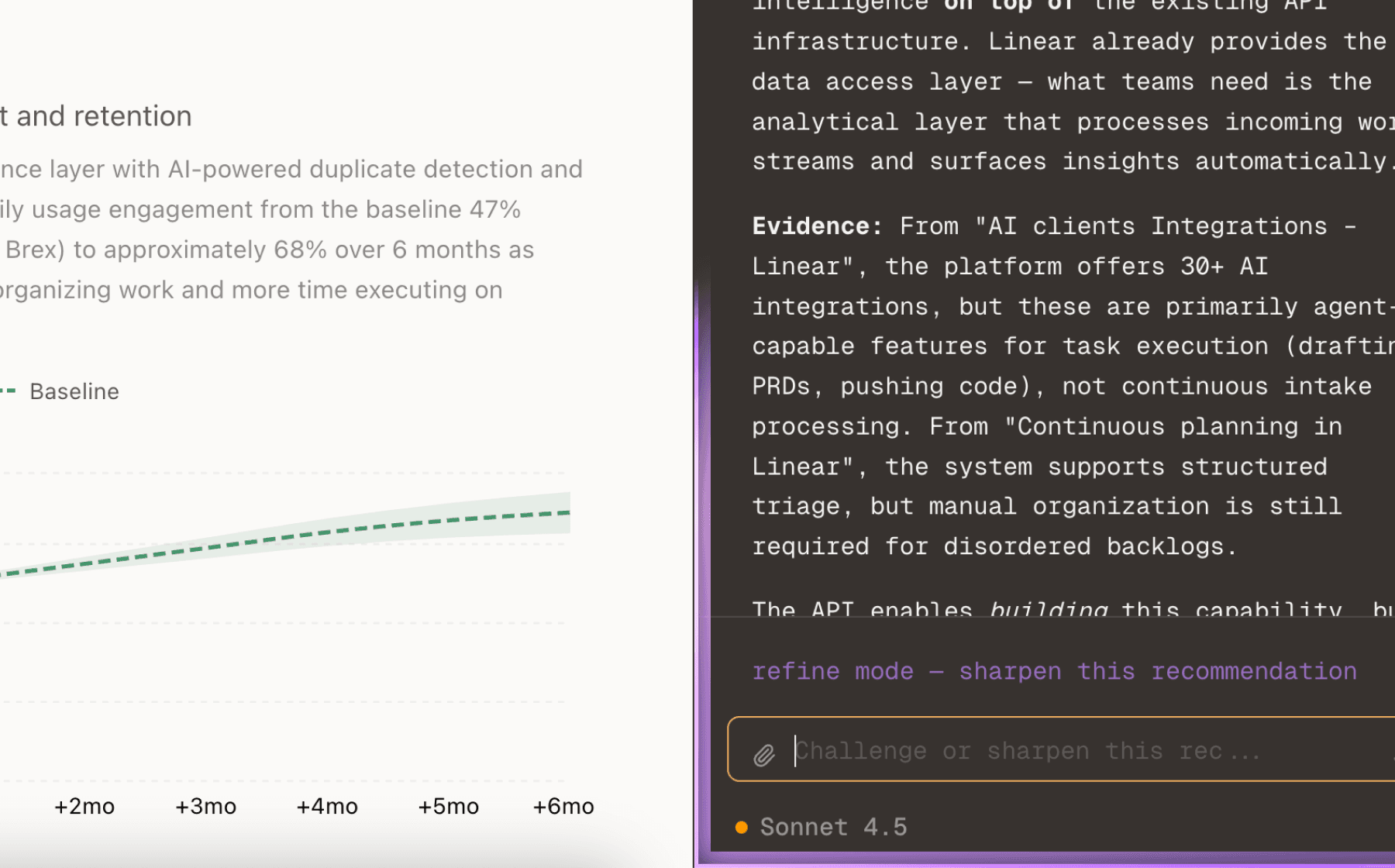
Chat with your data
Ask follow-up questions, refine recommendations, and capture business context through natural conversation.

Specs your agents can ship
Go from insight to implementation spec to code-ready tasks in one click.
This analysis used public data only. Imagine what Mimir finds with your customer interviews and product analytics.
Try with your dataMore recommendations
5 additional recommendations generated from the same analysis
Helium price increases of 400%-1000% since 2000 and competing AI datacenter demand create an urgent economic forcing function that diving operations cannot ignore. Hydrogen generated from water offers superior depth performance while completely eliminating exposure to rare-earth gas supply chains and price volatility.
Oxygen logistics present an immense bottleneck preventing space habitation, and existing demonstrations position this technology as a potential solution. Water is already present on the ISS and future space stations, making water-based oxygen generation a natural fit that eliminates costly resupply missions.
The core oxygen generation technology applies across diving, space travel, hospitals, emergency response, firefighting, and aviation. Building application-specific systems for each market would fragment development resources and slow time-to-market across all segments.
Current tanks are heavy, impractical obstacles that constrain diver movement and create operational limitations. The product vision explicitly calls out advancing movement underwater and on-land without removing gear due to weight. Converting this into quantified messaging creates immediate differentiation that resonates with users frustrated by tank limitations.
Diving technology nearly 100 years old creates fatal oxygen deprivation scenarios, yet inertia keeps operations using these systems because they represent known, certified approaches. Overcoming this inertia requires a clear safety certification pathway that demonstrates the tankless system meets or exceeds existing safety standards while eliminating specific failure modes inherent to tank systems.
Insights
Themes and patterns synthesized from customer feedback
The water-based oxygen generation technology has been proven through working demonstrations that have been captured on film, moving the solution from theoretical concept to validated prototype. This proof-of-concept evidence supports progression toward product development and commercialization.
“We wanted to prove its possible and filmed it for you to see for yourself”
Oxygen generation solutions have immediate applicability across space travel, high altitude operations, hospitals, emergency response, firefighting, and aviation. The broad addressable market extends far beyond diving and includes critical life-safety applications across healthcare, emergency services, and exploration domains.
“It will open a new dimension in Diving, Space Travel, High Altitudes, Hospitals, Emergencies, Firefighters, Airplanes....”
Moving from traditional gas-and-lungs thinking to an atomic and electron-level understanding of respiration enables fundamentally different system design that is not constrained by current breathing apparatus limitations. This paradigm shift is necessary to unlock solutions for extreme environments like space, deep ocean, and high altitude.
“If we ever want to live in space, tap into our underwater domain to the fullest or save our loved ones when in need - we should not think in terms of Gas and Lungs, but rather Atoms and Electrons”
Hydrogen functions as an inert gas that delivers better performance at depth than the currently standard nitrogen or increasingly scarce helium. Generating hydrogen from water provides both a superior technical solution and eliminates dependence on scarce rare-earth inert gases.
“From water wonderfully we also get the incredible inert gas - Hydrogen, which works much better in depths than Nitrogen or Helium”
Pressurized gas tanks used in current diving and breathing systems are inherently heavy, difficult to manage, flammable hazards that represent obsolete technology. Tankless solutions would reduce operational weight, eliminate flammability risks, and improve user mobility and safety across all applications.
“We carry heavy, impractical and dangerously flammable tanks in an era where tanks should be obsolete”
Helium prices have risen 400%-1000% since 2000, and competing demand from AI-datacenter cooling may further deprioritize helium availability for deep sea diving missions. This creates an urgent need for alternative inert gas solutions that don't rely on increasingly scarce rare-earth elements.
“Helium has only increased 400% - 1000% in price since year 2000”
Diving equipment nearly 100 years old relies on gas tanks that create fatal risk scenarios where divers run out of oxygen at depth and cannot return to their families. The technology has not evolved to meet modern safety standards despite the life-or-death nature of the application.
“We use diving tech that is soon going to be 100 years old and assume someone is "just gonna do the job" down there at the ocean floor with a risk of never seeing their family again due to running out of oxygen”
Water molecules are available on land, sea, air, and space, making them a universal feedstock for generating breathable oxygen across all human operating domains. By replicating the dark oxygen production that naturally occurs in ocean depths, oxygen can be generated locally wherever water is available, eliminating dependence on logistics networks.
“The only answer to the problems we have lies in water - the water molecule available on Land, Sea, Air and Space”
Immense logistical challenges in delivering sufficient oxygen to space prevent human settlement beyond Earth. Current tank-based oxygen transport is impractical for sustained space operations and blocks a fundamental requirement for off-world human habitation.
“How are we going to solve the immense logistics bottlenecks in oxygen delivery to space for us to finally be able to live there?”
Run this analysis on your own data
Upload feedback, interviews, or metrics. Get results like these in under 60 seconds.