What ComplyDo users actually want
Mimir analyzed 4 public sources — app reviews, Reddit threads, forum posts — and surfaced 9 patterns with 7 actionable recommendations.
This is a preview. Mimir does this with your customer interviews, support tickets, and analytics in under 60 seconds.
Top recommendation
AI-generated, ranked by impact and evidence strength
Build guided gap remediation workflows with automated tracking and evidence collection
High impact · Large effort
Rationale
The platform identifies compliance gaps quickly — sample deployments show 71% coverage with one-third of requirements needing attention — but lacks structured workflows to close those gaps. Enterprises spend $206,000 annually on consultants partly because they don't have clear processes to remediate identified deficiencies. Current automation stops at assessment, leaving teams to manually coordinate remediation across security, legal, and operations.
A guided remediation system would turn gap assessments from diagnostic reports into action plans. This means task assignment, progress tracking, automated evidence collection reminders, and integration with existing control implementation tools. The value compounds over time as organizations build reusable remediation playbooks for common gap patterns across frameworks.
This directly supports the core promise of eliminating manual work (currently 86% reduction) by addressing the post-assessment phase where most manual coordination happens. It also strengthens the always-on advisor positioning by providing continuous guidance through implementation, not just initial analysis.
Projected impact
The full product behind this analysis
Mimir doesn't just analyze — it's a complete product management workflow from feedback to shipped feature.
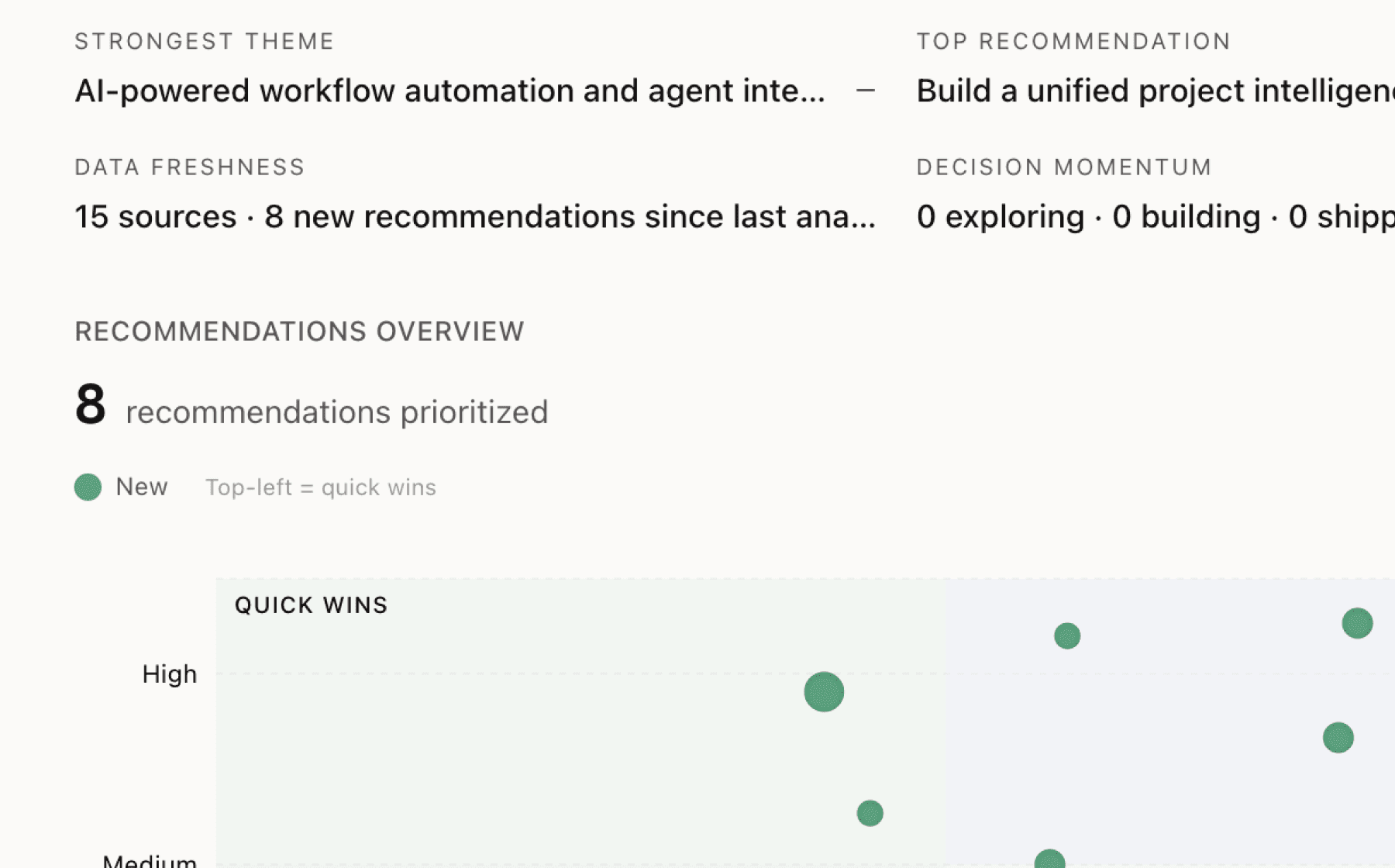
Evidence-backed insights
Every insight traces back to real customer signals. No hunches, no guesses.
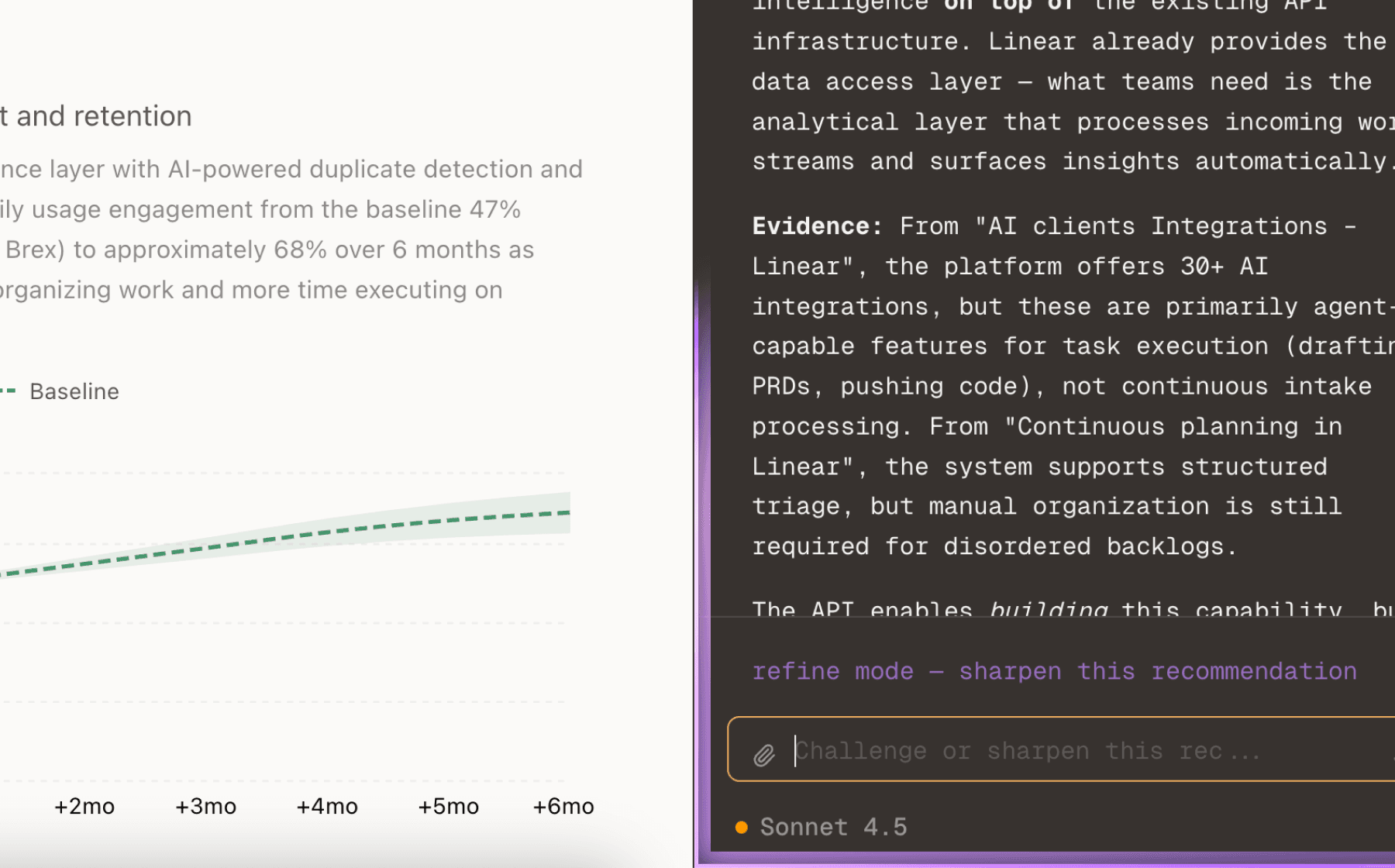
Chat with your data
Ask follow-up questions, refine recommendations, and capture business context through natural conversation.
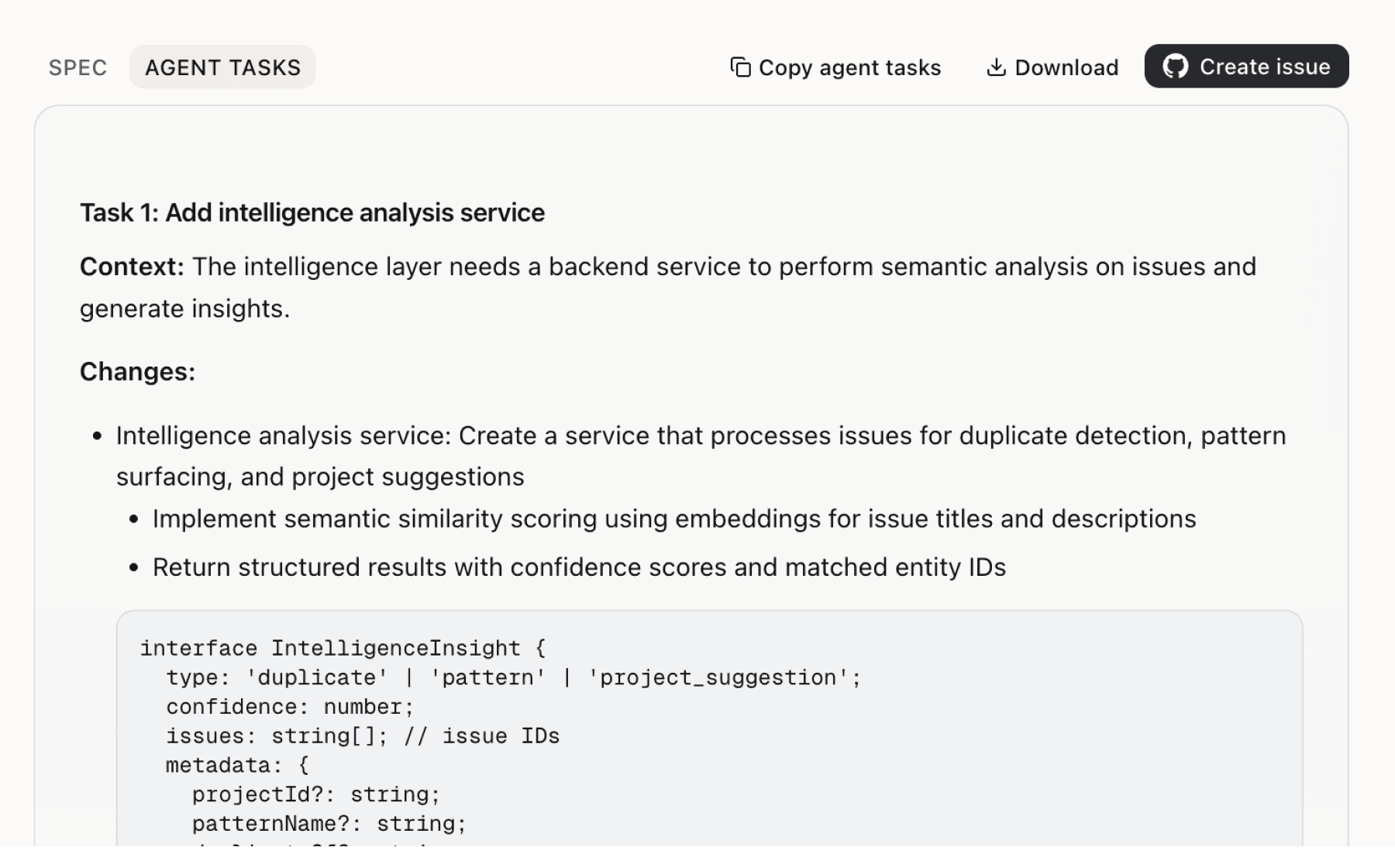
Specs your agents can ship
Go from insight to implementation spec to code-ready tasks in one click.
This analysis used public data only. Imagine what Mimir finds with your customer interviews and product analytics.
Try with your dataMore recommendations
6 additional recommendations generated from the same analysis
Third-party risk management relies heavily on spreadsheets, manual follow-ups, and fragmented documentation across procurement, security, and compliance functions. Enterprises struggle to consolidate supplier assessments and maintain visibility into regulatory overlaps, creating operational friction that undermines the platform's efficiency gains.
Consulting firms build reusable knowledge bases across client engagements to increase margins without additional headcount, but most enterprises reinvent mappings for common frameworks. The platform generates automatic mappings, yet each organization starts from scratch rather than benefiting from collective intelligence across implementations.
The platform positions enterprise security as a core value proposition while serving compliance teams at regulated organizations handling sensitive audit data. The privacy policy states that no transmission method is 100% secure and relies on commercially acceptable means without specifics. For buyers evaluating compliance tools, vague security assurances create procurement friction.
Compliance documentation becomes fragmented and slow to update, creating uncertainty about whether policies align with implemented controls. Organizations maintain regulatory alignment manually, checking whether policy changes require control updates or vice versa. This creates audit risk and rework when misalignment surfaces during assessments.
Enterprises face a growing number of global regulations including ISO 27001, NIS-2, DORA, ARR, and ECC. The platform supports DORA, ISO, and custom frameworks with automatic adaptation, but enterprises evaluating the tool need confidence that emerging frameworks will be supported without custom development work or delays.
The platform transfers personal data outside user jurisdictions where data protection laws may differ, requiring user consent for transfers. For compliance-focused customers, the tool that manages their compliance program must itself demonstrate strong data governance. Data shared with service providers, affiliates, and business partners creates complexity that compliance teams scrutinize.
Insights
Themes and patterns synthesized from customer feedback
ComplyDo currently supports a broad range of compliance frameworks (DORA, ISO, TOMs, and custom frameworks), but enterprises may require support for additional emerging or specialized frameworks with automatic adaptation capabilities. Framework coverage breadth is a factor in enterprise deployment decisions.
“Support for all compliance frameworks including DORA, ISO, TOMs, and custom frameworks with automatic adaptation”
Sample dashboard data shows 71% coverage achieved, indicating that one-third of compliance gaps require attention during initial implementations. This suggests the need for clear workflows to address identified gaps and potentially more granular gap remediation capabilities.
“71% coverage achieved in sample dashboard with compliance gaps requiring attention”
ComplyDo retains personal data as long as necessary for stated purposes, with usage data retained for shorter periods unless required for security or legal compliance. Users can request data deletion through account settings or direct contact, subject to legal retention obligations.
“Personal data retained as long as necessary for stated purposes; usage data retained for shorter periods unless required for security or legal compliance”
Automatic extraction of requirements from compliance files and intelligent mapping to internal controls eliminates manual interpretation work, enabling organizations to understand new frameworks in minutes rather than weeks. This automation improves audit readiness, reduces delivery risk, and increases project margins without additional headcount.
“Automated gap assessment capability that processes any file and generates assessment in 20 minutes without manual input”
ComplyDo collects personally identifiable information, usage data, and device identifiers, with data shared among service providers, affiliates, and business partners. Personal data may be transferred outside user jurisdictions where data protection laws differ, and is disclosed to law enforcement when legally required, requiring clear user consent and transparency mechanisms.
“Service collects personally identifiable information including email address, first and last name, and usage data from users”
Organizations currently rely on expensive external consultants for compliance interpretation and advisory work. ComplyDo provides continuous AI-driven compliance consulting that serves as an always-on advisor without hourly billing, enabling GRC teams to achieve 10x efficiency improvement and reusable knowledge bases that increase project margins.
“AI-driven compliance consulting capability serving as always-on advisor without hourly billing”
Enterprises struggle with fragmented compliance documentation, spreadsheet-dependent supplier management, and poor visibility across multiple frameworks and geographies, making it difficult to consolidate assessments and maintain regulatory alignment. Automated policy analysis and unified audit workspaces provide end-to-end transparency and improved collaboration between compliance, security, and procurement functions.
“Documentation fragmented and slow to update, creating uncertainty and inefficiency”
The platform positions 'Enterprise Security' as a key value proposition, yet the privacy policy states that no method of internet transmission or electronic storage is guaranteed 100% secure and relies on commercially acceptable security means. For a compliance-focused product serving regulated enterprises handling sensitive control and audit data, more specific security assurances and encryption details would strengthen user confidence.
“Product emphasizes 'Enterprise Security' as a key positioning/value proposition.”
Compliance teams face escalating costs from manual mapping, consulting fees, and delayed audits as global regulations multiply. ComplyDo's automation eliminates 86% of manual work on average, delivering gap assessments in 20 minutes versus weeks, and generates $206,000 in annual savings per enterprise through avoided consulting fees and improved efficiency.
“In enterprises, complexity drives cost and risk. ComplyDo replaces manual compliance tasks like interpretation, mapping and expensive advisory work with structured, auditable automation.”
Run this analysis on your own data
Upload feedback, interviews, or metrics. Get results like these in under 60 seconds.